2023 Turnings


It is January 2024, and this year I want to build the site for the year as I go along. However, 2023 is not yet built, so I will start on it and try to complete it in a week or two. The writing and coding take time, and resizing the photos and editing those is also a bit of a chore. It is always enjoyable to fire up the page for the first time, though, and see the results of my work.

In my later years I have begun trying to connect with people I knew a long time ago and with whom I had lost touch. My old college roommate, some fellows I sang with back in the 60's, and connections made in college but lost over time. I found it very handy to point them to this website which basically tells the story of my life since I last saw them. It is so much fun to connect with people who you have not spoken to in more than 50 years.

Enjoy these images and little stories. I am definitely slowing down in the shop, primarily because I am running out of space to put, and store finished work. Need to hit a few sales.

I love hearing from you, so feel free to let me know you were here.


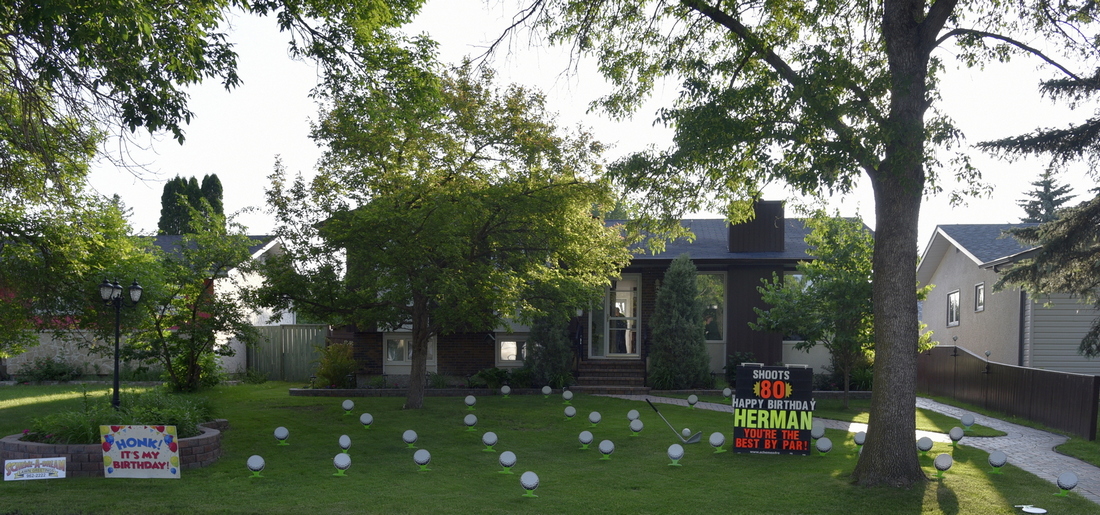
So, I woke up on the morning of the 8th of June and opened the blinds to check the weather, and this is what I saw.

At some point, in the middle of the night, some mysterious gremlins silently erected the scene you see here, and I think perhaps the horns of people going to work early may have awakened me. As I stood outside a school bus full of kids went by with the driver laying on the horn and the kids waving from the bus. All day long this went on, and I knew I had been defeated in trying to keep my birthday low key.

The most memorable moment came about 7:00 in the evening when the doorbell rang. There stood two young mothers, one holding a baby, and five other children between 3 to 7 years in age. I had no idea who they were, but they were of East Indian nationality and recent newcomers to Canada.

They said, “Is there a birthday here?”, and when I said there was, they said, “We just stopped on our walk to sing Happy Birthday.”

I was floored. They sang a few lines of the song, then stopped, and asked who was having the birthday. I told them it was me, and they said, “But the sign says 80, and you don’t look 80.” I assured them that, reluctantly, the sign was right, and they had paid me a nice compliment. Besides that, their spontaneous and pleasant actions had made it a very special day for me.

I have no idea who is responsible for the yard display. And, although Karen was watching to see when they were going to come and get their stuff, it mysteriously disappeared during a 10-minute window when she wasn’t looking about 11:00 at night. Our dog hears everything, but she never said a thing when they set it up and took it down.

It was a great day, and I thought I would share this little surprise with all of you.

I have posted so many peppermills I almost hate to post a couple more. But they are something I continue to like to make, and these are the only ones I did in 2023.

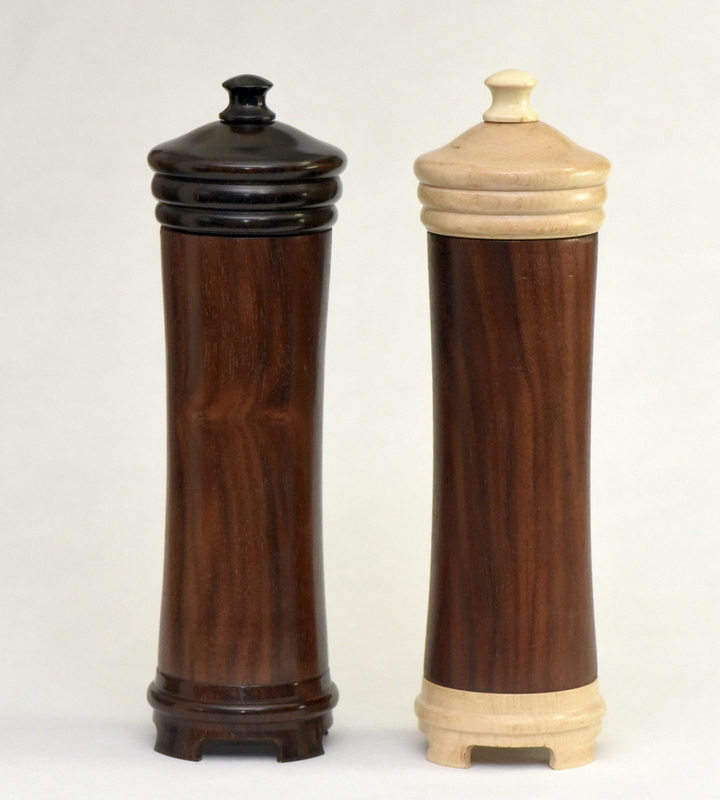
On the left is a set of 8" walnut pepper and salt mills, made at the request of my niece for her husband as a gift. I had previously made a salad bowl for them which I neglected to photograph.

The one with the dark top and base is obviously for pepper, and it is made of walnut with cocobolo base and top and an adjustment knob of ebony. The mill with the light top and base is walnut and maple, and the adjustment knob is of holly. The salt mill is ceramic and stainless steel to avoid corrosion of the mechanism, and the peppermill is the usual Peugot steel mechanism.

I hope these have a long life with my nephew's family, and I was told their daughters are already in discussion who will eventually inherit the mills.

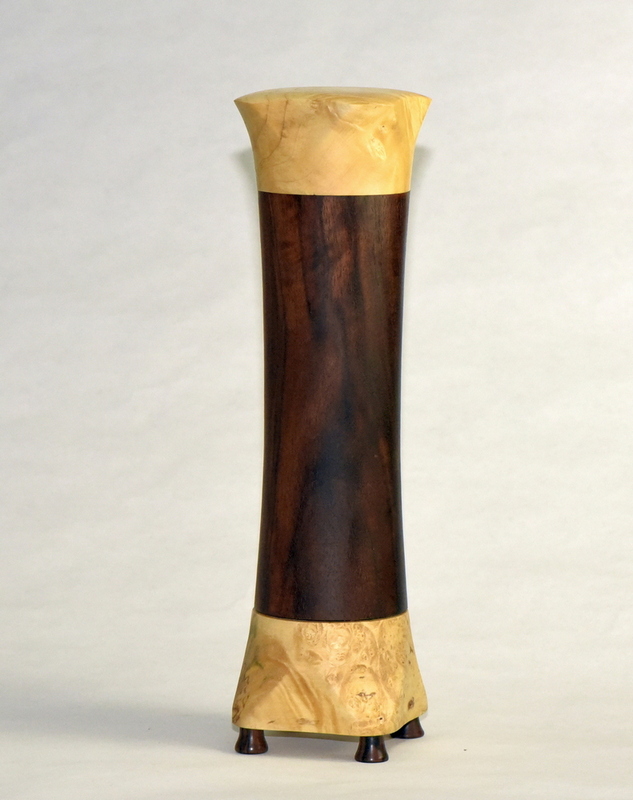
On the right, the third mill is made of walnut with a base and top of maple. The four little foot pads are also made of walnut. The mill is 10" tall.


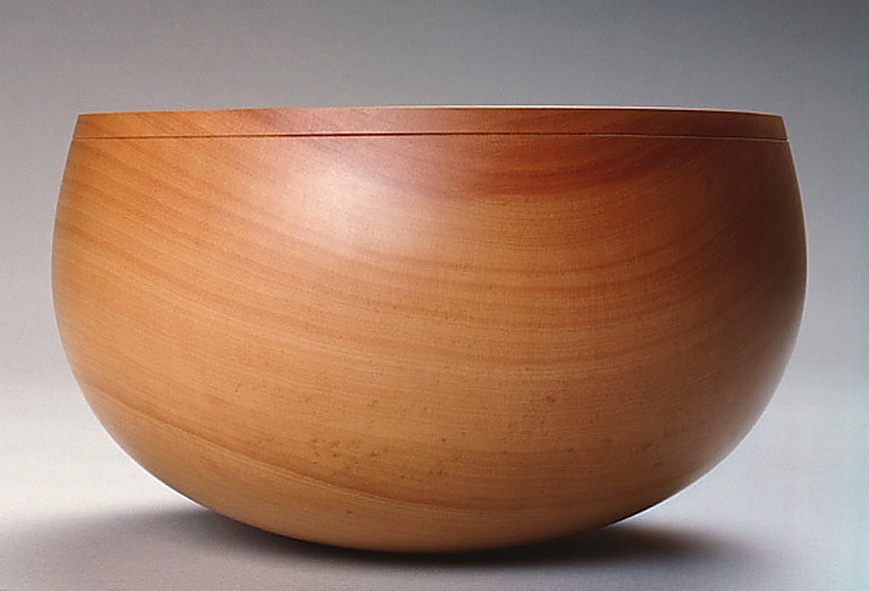
Here is the "perfect bowl".

Now, before you begin to think I have gone over the top with my ego, let me explain.

Years ago, a wonderful and respected turner by the name of Bill Luce published a set of proportions and a photo of what was dubbed the "Perfect Bowl" in terms of curve, flow, and proportions. A member of the World of Woodturners posted the information on the site, and I thought it would be fun to try, and then to attempt a demonstration for our club.

This was my first attempt at making the bowl, and I used a piece of Schubert chokecherry to attempt it. I found the bowl a remarkably difficult piece to mimic, which surprised me. The proportions were exactly as Luce had recommended, but the flow and the curve required a concentrating on the curve more than I expected. Just a millimeter too shallow or too deep in any one spot would completely change the form, so I turned off the shop radio, cleared all clutter away from the piece and cranked up my concentration.

I'm pleased with the result. While the bowl is not exactly the same (I used a small rim at the top as I mistook Luce's little V-groove at the top of his photo), and that is the difference. But I do like my version, and I had a lot of fun doing it. I will do others.

In the frame below, I will show you the original photo of Bill Luce's bowl, and the poor result of my demo for our club.

On the left is the Bill Luce bowl that I used as my example. I did not include the diagram with the proportions for the various elements of the bowl, but this is the photo of his actual bowl. As you can see, and which I now know, the rim is simply implied by the shallow V-groove at the top of the bowl, while I made an actual rim on the bowl.

The small Manitoba maple bowl on the right is the bowl I turned at the woodturner's club meeting. It was perfectly proportioned at the meeting, but when I took it home to finish it I realized I had made a mistake in calculations and made the inside too shallow. I did not catch the error until I had turned away the foot and realized my proportions were off. So - the bowl is a smidgen too short. And that is an example of losing your focus and concentration with trying this. Regardless, this still turned out to be a pretty bowl.

I do not like exact copying and will never do that without acknowledging that I am copying someone else's work. However, I think that trying to make an exact copy is a good learning exercise, and often encourage students to copy for that reason. The advice is always coupled with the admonition to never sell a copy as your own idea, or to claim credit for yourself. But the experience becomes part of your subconscious memory and muscle memory to aid in your growth as a woodturner. None of us are completely original. All of us - and mostly without our knowledge - have dredged up images and parts of images from our subconscious minds of stuff we have seen before and used it in our creations. But when we are aware that someone else has been an influence, it is gracious, honest, and classy to give credit.


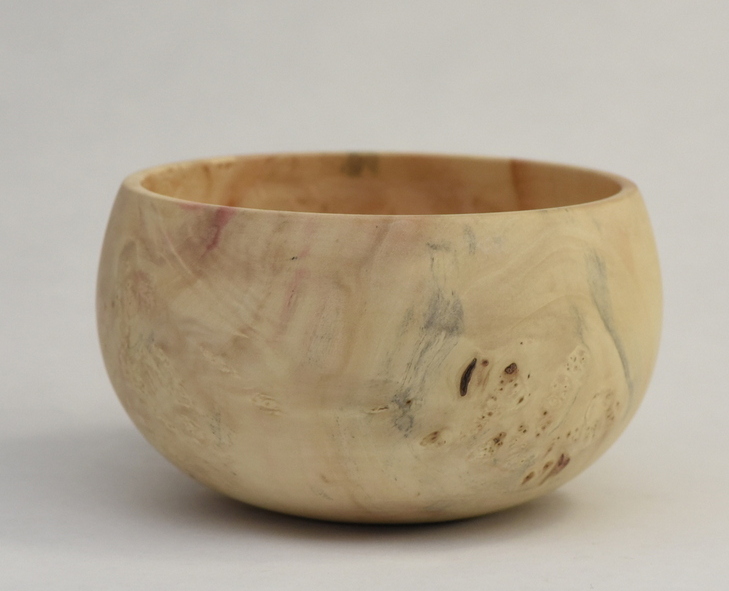
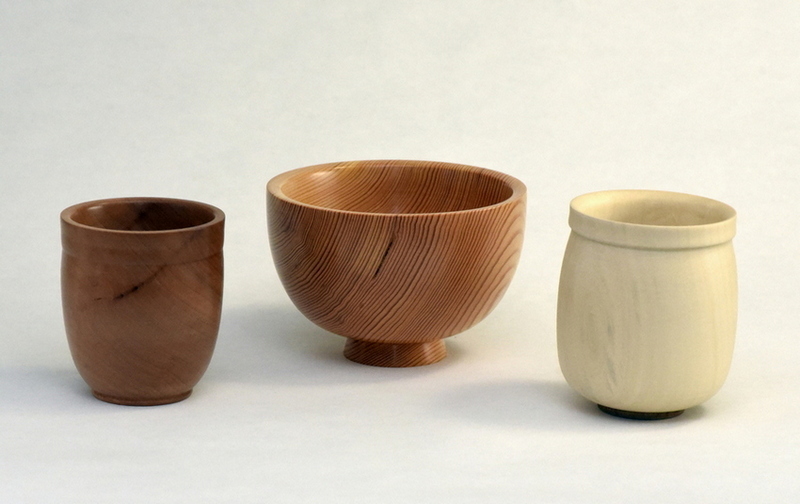
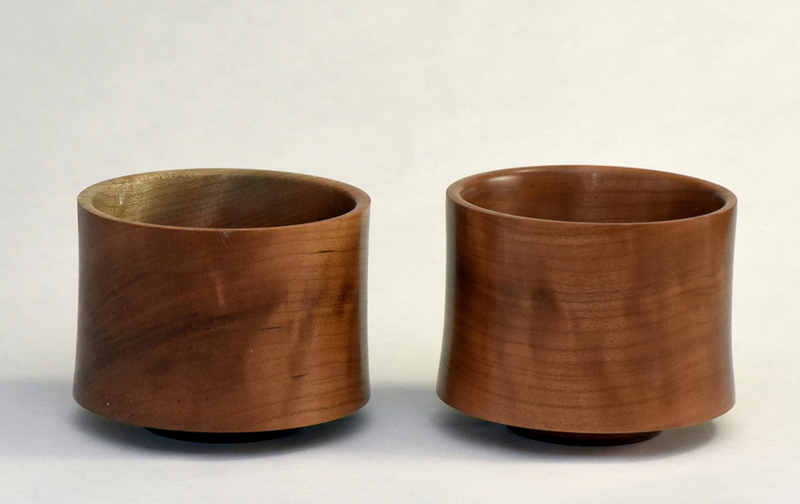
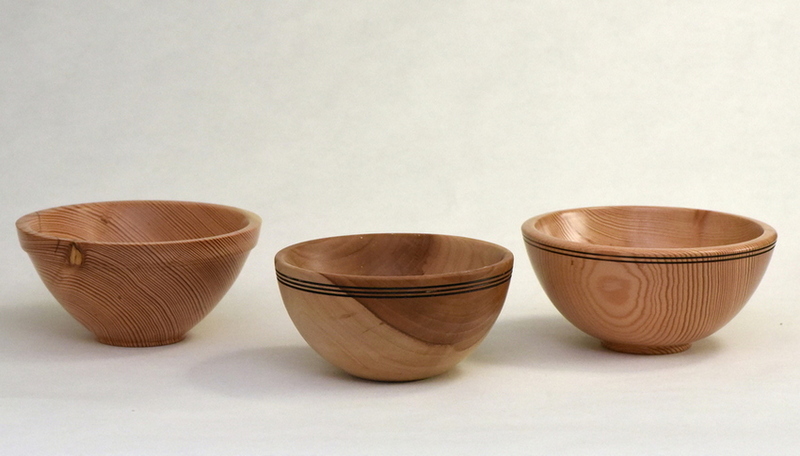
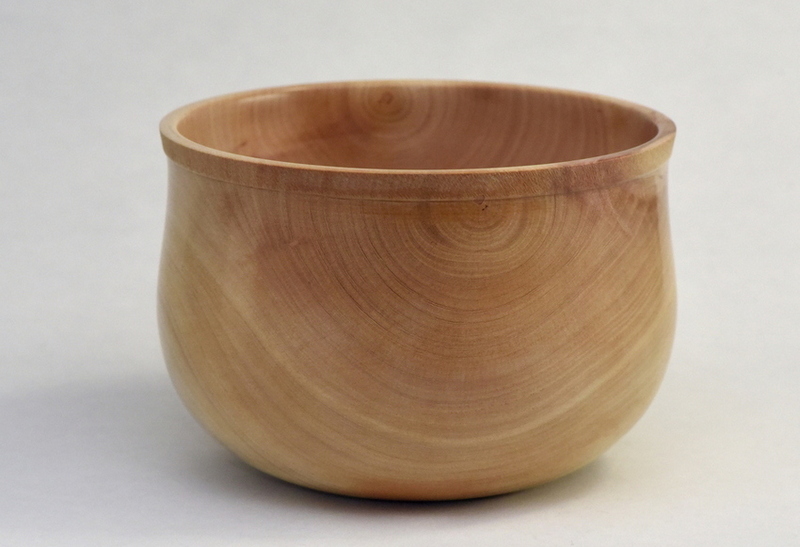
From other years' postings you already know that I like to turn small bowls, especially as practice and to get a more visual interpretation of what I might be planning for a large bowl. I often encourage students and club members to follow that lead as it is a perfect way to develop the "muscle and visual memory" that becomes an invaluable tool in woodturning. Muscle memory and visual memory only comes from practice. So here is a series of small bowls done for practice and for quick, less pricey items at a sale.

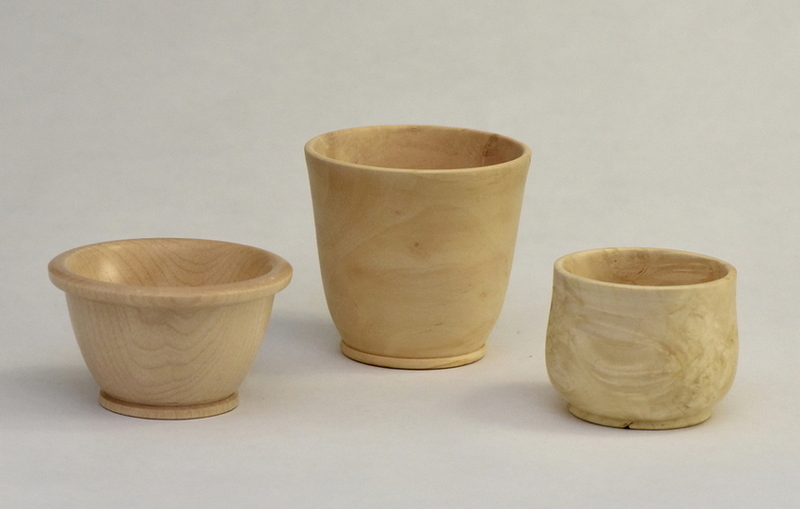
Top left is three small bowls - arbutus, fir and box elder. The fir bowl was inspired by some of the rice bowls I have seen from Japan. They are all about 3" tall.

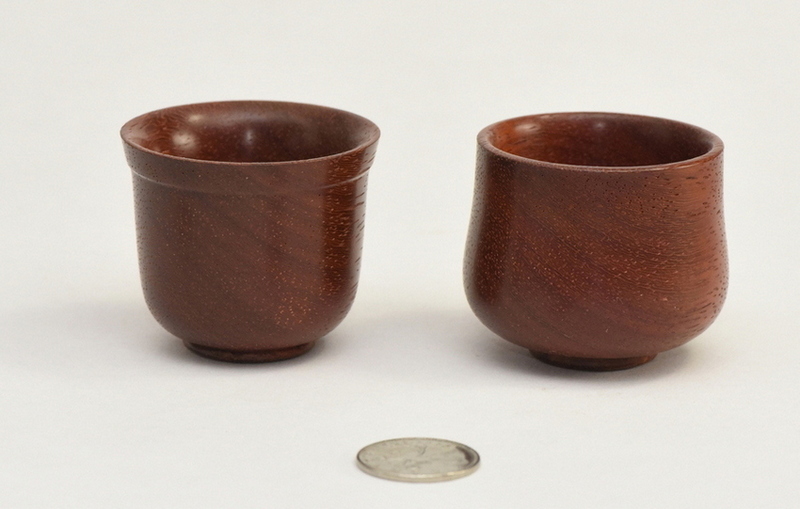
Top right is two Japanese tea bowls made of cherry. They are coated with epoxy UV-cured resin on the inside to make them impervious to moisture. About 2.5" tall.

Middle left are two fir bowls on the outside and a Schubert chokecherry bowl in the middle, and about 2.5" tall.

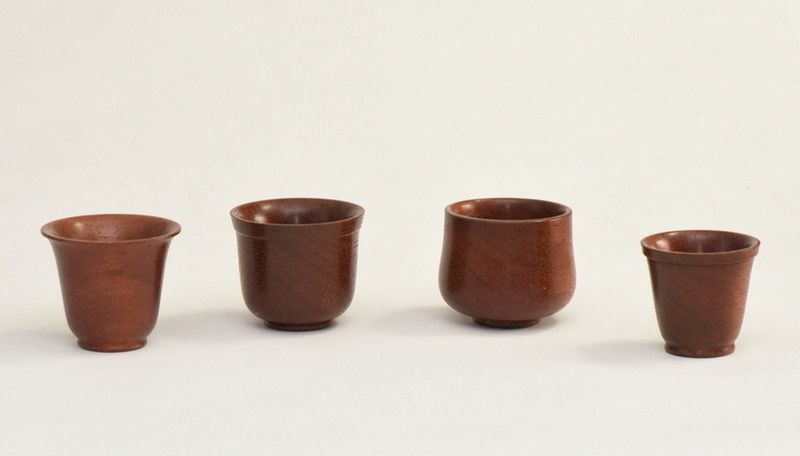
Middle right is four tiny,1.25" tall bowls made of madrone - I think.

Bottom left, I show you two of the previous bowls with a quarter for perspective.

Bottom right is three 1.5" bowls of box elder (Manitoba maple).


These two bowls are presented as examples of side grain and end grain turning. The top left bowl, called "not a calabash" is turned from maple with the grain running across the width of the bowl. This is known as "side-grain" orientation of the bowl and is the usual grain orientation for bowls. You can clearly see the deliberate inclusion of the pith (very center of the trunk) included in the bowl. The pith is almost always excluded from a bowl since the pith is the primary location for cracks and splits. In this case, I left it there because it adds to the design.

The bowl on the right is similar in form, so I called it "Also not a calabash". It is more likely to be called a umeke, which usually is taller than wide. The smaller bowl is turned with "end-grain" orientation, which means the grain runs in a vertical direction through the bowl. This is also more commonly known as "spindle direction", which is how a spindle (for a chair, for example) would be turned. The different orientations produce a different look. Spindle orientation generally is less showy than side-grain, hence the addition of a wide bead at the rim and the little foot.

Both bowls are about 4" tall.

Two bowls here with enhanced feature rings.

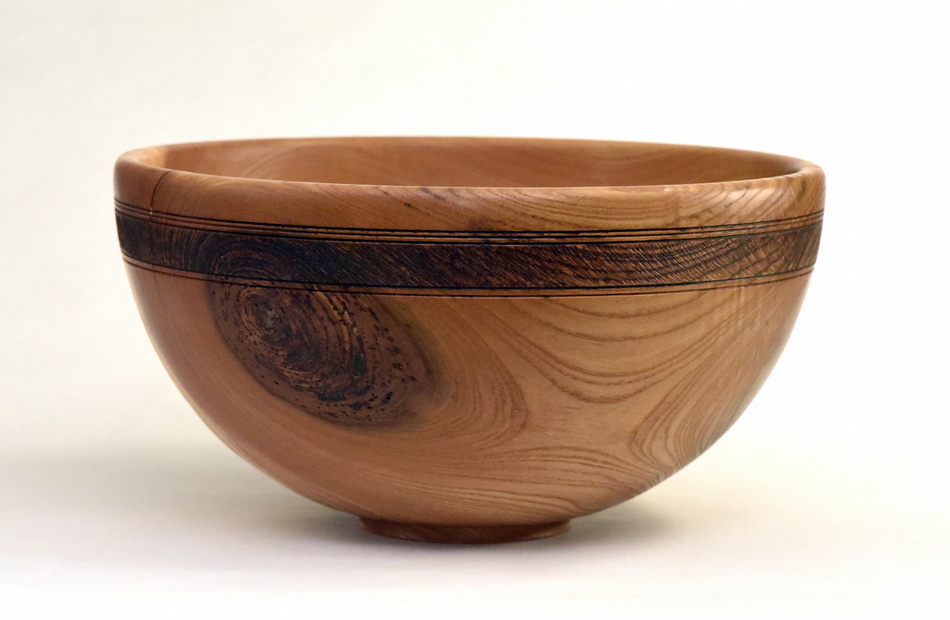
The ash bowl in the upper panel has a very natural feature of a knot where a branch once came out from the trunk and then darkened as it spalted. I liked that and deliberately included it in the design. Once done, it seemed like something more was needed, so I added a feature ring done with a burr in a Foredom carver (like a Dremel) and burn lines. The feature ring also was given a slight dye job with some stain before finishing.

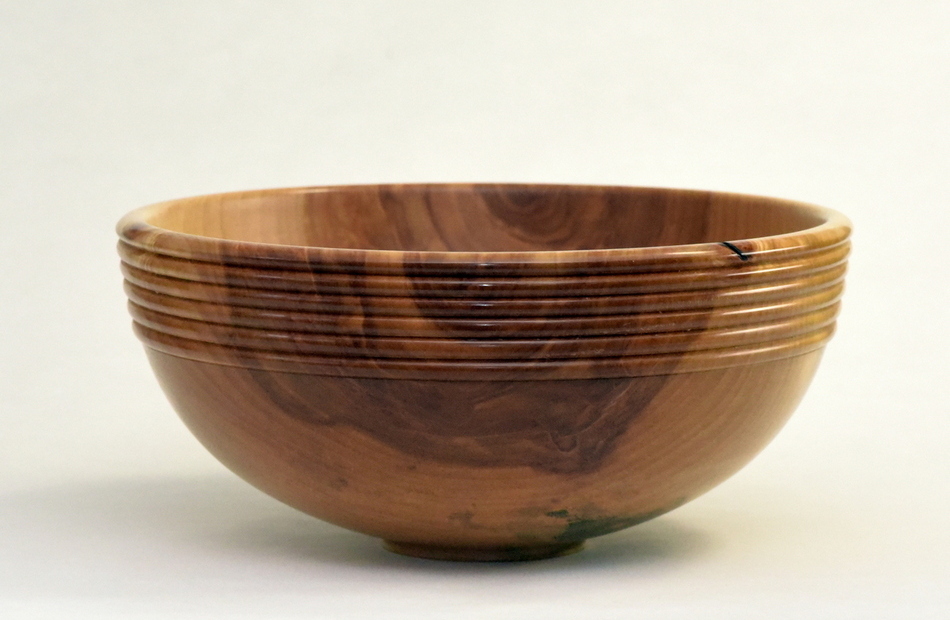
The bowl in the lower panel is made of apple, and the feature rings are simple beads, but also cut across the pith of the tree. The pith is usually excluded but I left it in this bowl as it seemed stable and added interest with the beads running across it.

Both bowls have feet, which Karen likes and which are starting to grow on me, too. I will do more bowls with feet in the future.

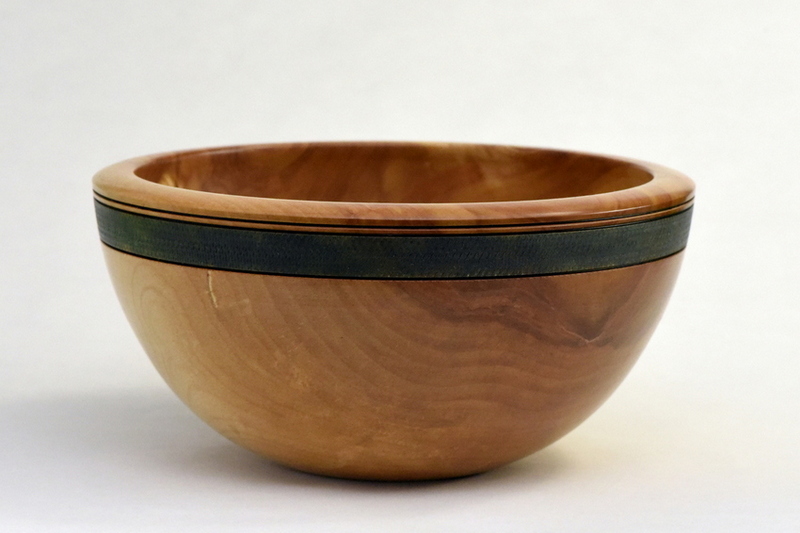
I love it when I can lay my hands on some Schubert chokecherry wood. It is becoming rare here in Winnipeg, as so many of the trees planted by the city years ago have died due to "black knot" disease. I miss the lovely purple-brown leaves in the summer and the berries the trees produced.

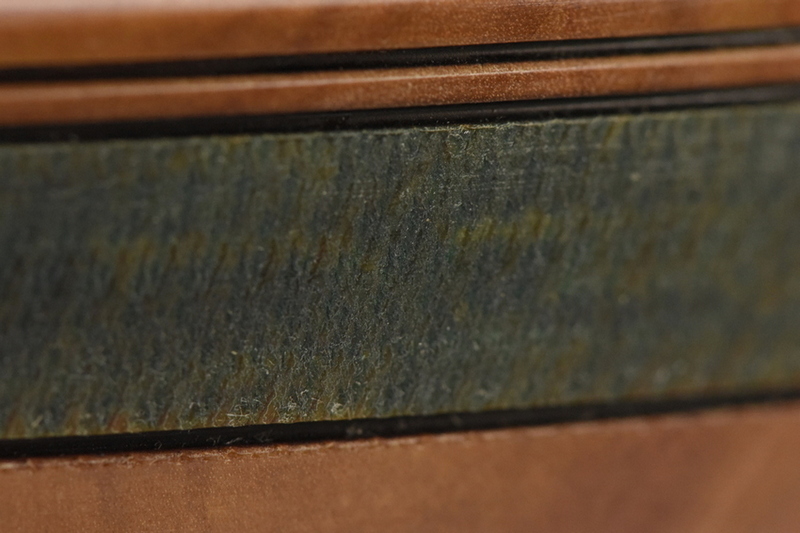
It is a beautiful wood to turn. Although it splits and warps as much as any fruitwood, it cuts nicely and smells nice during the turning, and it takes a beautiful finish. I added a textured feature ring and a little green dye to give it a little more pizzazz.

The photo on the right is a close-up of the textured section.

A customer called me and told me he was shutting down his woodshop, and did I want any wood?

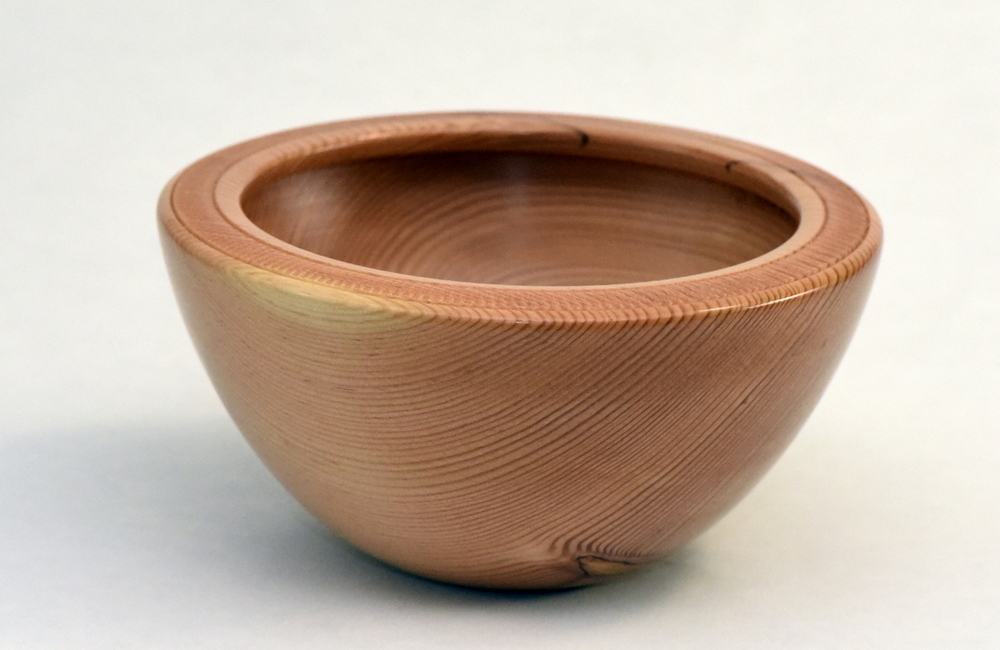
Like any woodturner, a chance to get some free wood is never turned down, so I went to see him. Among the few pieces I took was part of an old fir beam. and this little bowl is one of the pieces I could turn from the beam. It is only about 5" tall, but I will never again turn down a chance to turn some old fir. My - it does smell nice during the turning, and it makes the shop smell good. It is hard and splintery, and requires sharp tools to cut, but the result is a beautifully colored wood with a nice finish.

I decided to enhance the rim with a little texture and then finished it with tung oil.

This is my last entry for 2023. It has seemed like a short year and many times I found myself shy of inspiration and had no desire to enter the shop (studio). So, fortune has determined that I cannot be my usual long-winded self, and I must end this epistle. Oh well - 2024 is a new year!

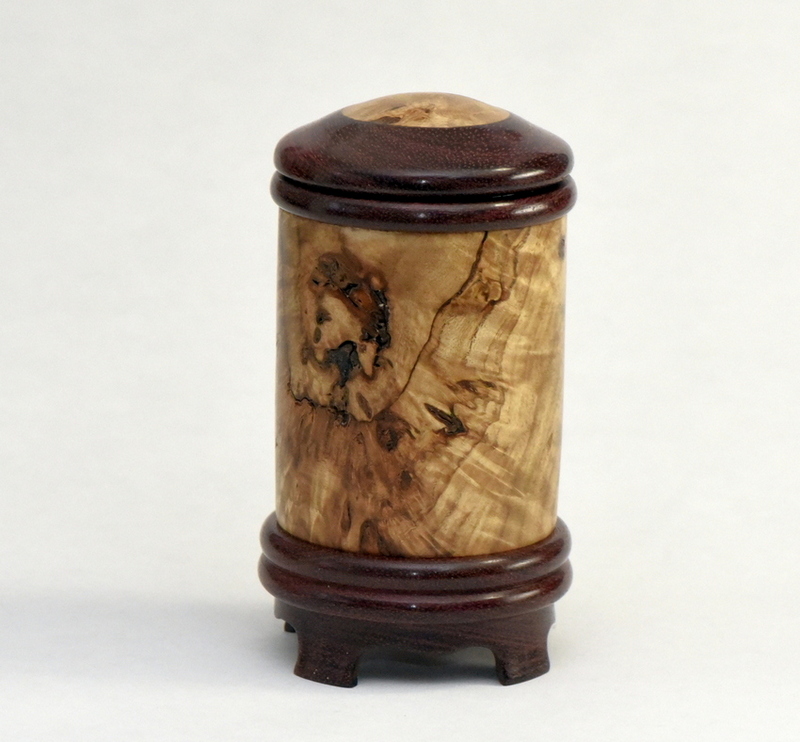
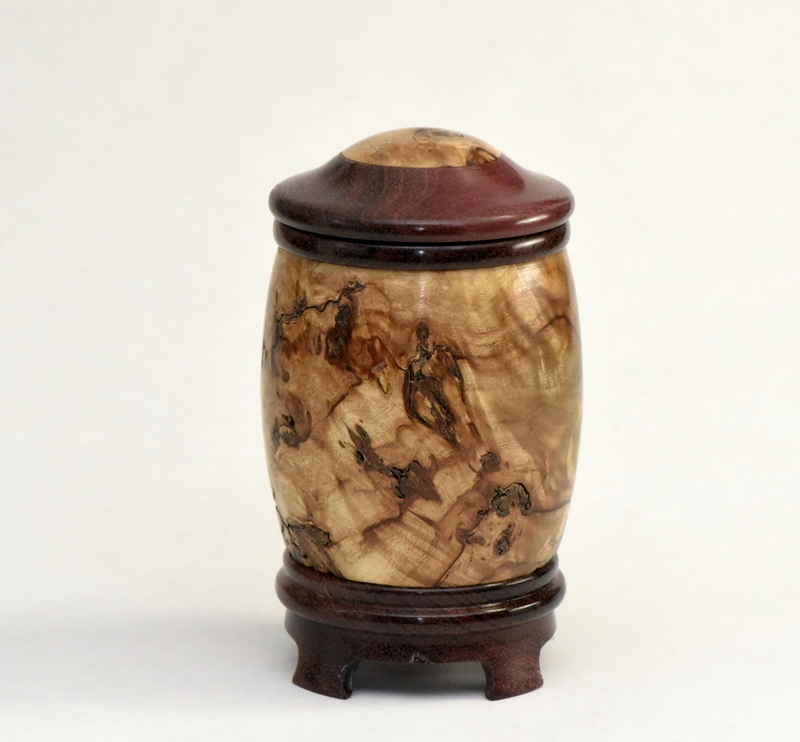
A friend gave me a few pieces of cottonwood burl a few years ago, and I found a remnant kicking around in the shop waiting to be turned into a bowl. I did not like the idea of a bowl, so I cut it into smaller pieces and turned these two boxes. They are both about 5.5" tall and 2.75" and 3" in diameter.

Cottonwood is kind of nasty to turn, and the burl wood was very soft and punky. I decided to give both boxes a bit of lift with a base and lid of purpleheart and a cottonwood cabochon in the middle of the lid. Each box required a ring of purpleheart to be glued on for a lid to be properly fitted. I did not like the purpleheart combined with cottonwood until the finish was applied. That changed everything, and now I really like how the two species work together.

After turning the first one, I decided to change the design a bit with the rounded sides on the second one. When I showed it to Karen, she immediately claimed it for herself. That is her right as the long-suffering wife of a woodturner makes sacrifices so we can indulge our passion for turning. Thus, she gets the first kick at the cat. My friend, who gave me the cottonwood, will get the second one.