2015 Turnings

It's December, 2015, and I just finished the 2013 and 2014 pages. Progress is being made!

I hope you like the work produced in 2015. There are a couple of different things in here, and I feel a bit better about the whole process than a year ago. Enjoy whatever you wish, and I hope you learn something and appreciate the beauty of the wood.

As usual, I love hearing from you, so feel free to let me know you were here.


I always like to start the year's photos with something a bit different.

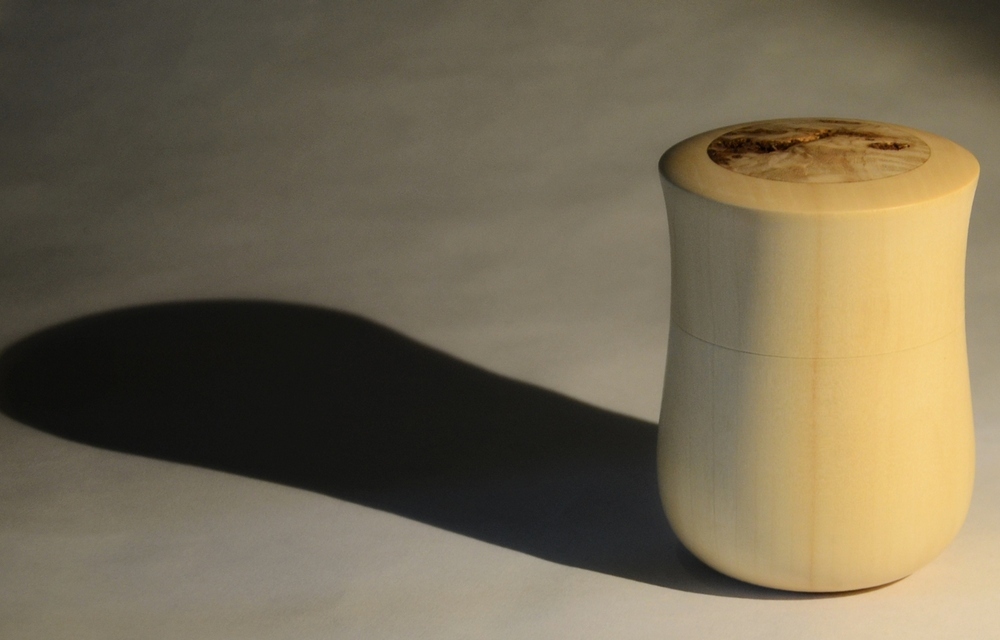
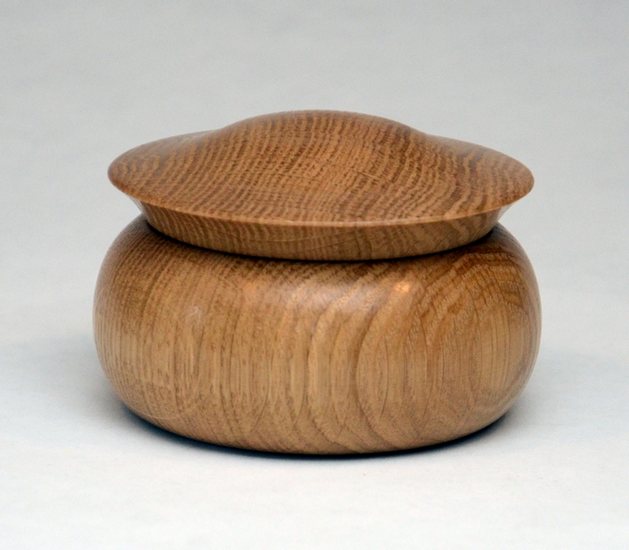
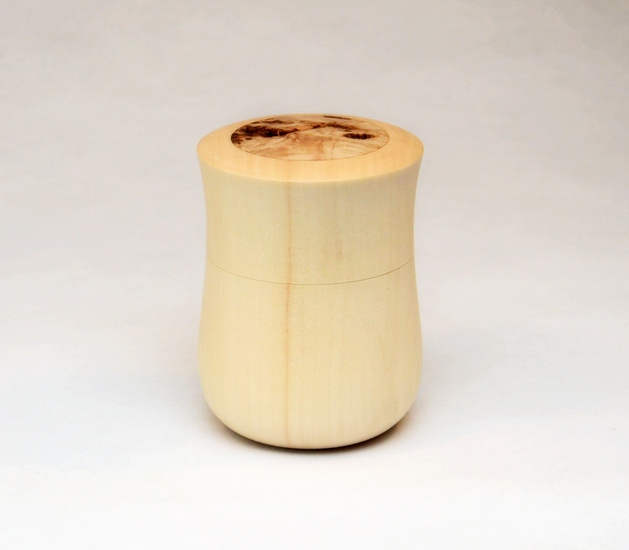
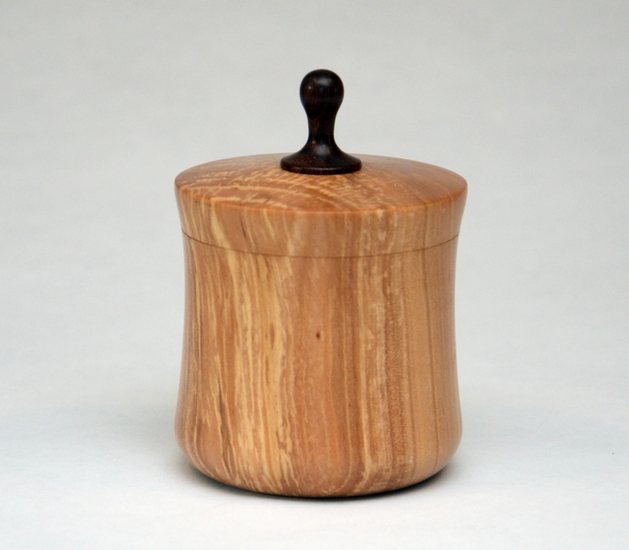
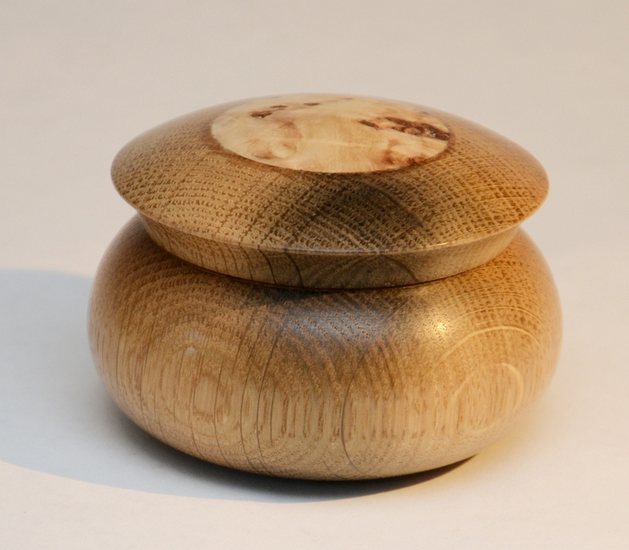
This one is different for a couple of reasons. First of all, it is just a simple box. Secondly, the photograph is a bit different. Thirdly, I did something with it that I had not done before, and that was to incorporate a different species of wood into the lid.

The wood of the box is simple, bland, Manitoba maple. Very little color and no pronounced grain. But the insert in the lid is cottonwood burl, and that has tons of color and grain and provided just the right contrast for this little box.

The box is about 3½" tall. The wood came from a corner of my shop, and the cottonwood from my Portage friend, Vern.

Maple & Cottonwood Box

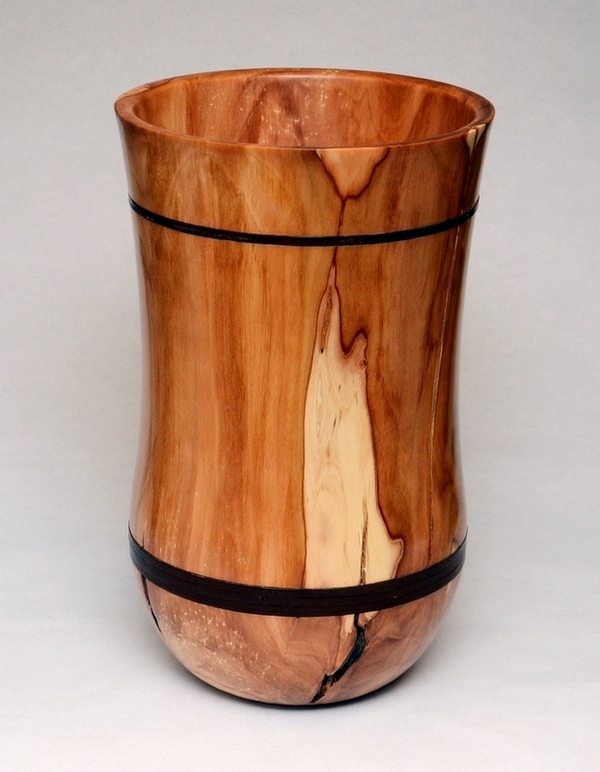
Schubert Chokecherry Vase
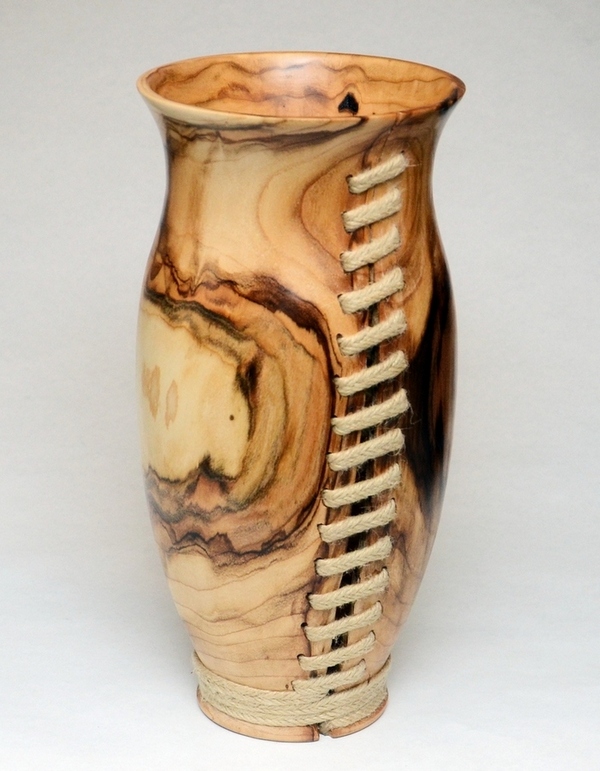
Split Scubert Chokecherry Vase

It is hard to believe that both of these came from the same tree, much less one just above the other in the trunk. Yet, they did, from a friend's tree. I knew that the wood was slightly split when I turned the two pieces right after the tree was cut, but over the next year, while the rough turning dried in my garage, the pieces split severely. The one on the right almost split completely in half. I almost threw them away and then had an idea. You know the old saying, "when life hands you lemons you make lemonade."

The vase on the left had more color to it, and the split was not quite as pronounced so I cut a single groove in the top part to accommodate a single strip of leather. Toward the bottom I carved a groove wide enough to accommodate three of the leather strips. Then it was a matter of applying contact cement to the underside of the leather and to the grooves and finally, working the leather into the grooves. I like the effect.

With the piece on the right, the crack ran almost all the way across the bottom. So, using my Foredom carver, I carved angled slots all along the split. Then, using wide jute cord I stitched the piece together.

The vases have been on display at several events, and they generate a lot of comment and a lot of interest. They are both about 14" tall, so they are not small. Early in 2016 they will be on display at an exhibition in Portage la Prairie, Manitoba.

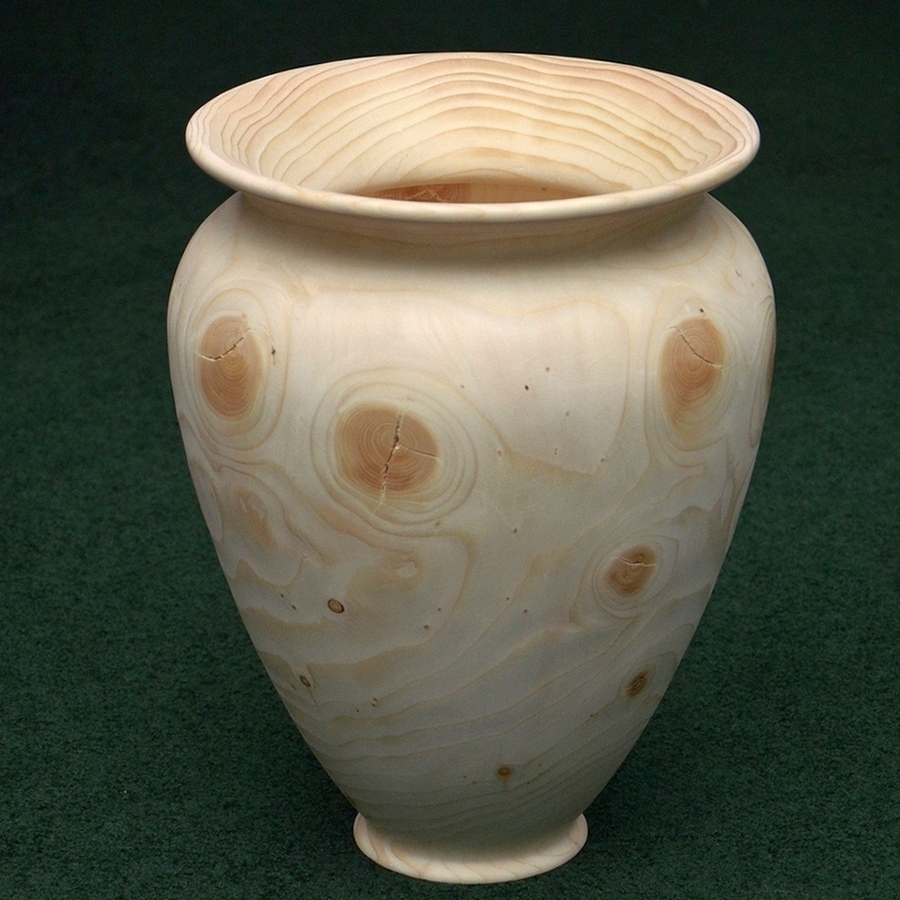
Spruce Vase

I really don't like spruce. And I have only turned one thing from spruce before. I hated it because it is sticky, and sappy, and stringy and is hard to sand. I swore I would never turn spruce.

So when Andy and Bill from across the street asked me if I wanted a piece of the big spruce as I stood with them watching a crew cut it down, I said "no".

But then I noticed a spot, about 20 feet up, where there were seven or eight branches poking out from the trunk all at the same level. I immediately saw a vase in there, with knots all around it - sort of like Norfolk Island Pine (NIP). I wondered if I could turn this thin and translucent like they do with the NIP in Hawaii.

So I grabbed the piece when it hit the ground and took it home, turned it wet, and then set it in the garage on a shelf for a year to dry. When I finish turned it, the piece turned beautifully, and a bonus was the "ripple" that developed as I sanded it on the lathe. The softer wood between the rings sands away more quickly than the harder material in the rings, and that gave the piece a beautiful texture. And it was a lovely creamy white.

I liked the white so I bleached it to make it even whiter and then used matter Krylon finish on it to keep the color light. This piece is 13" tall and about 9" in diameter.

It turns out that spruce is OK after all.

Walnut Pierced Form

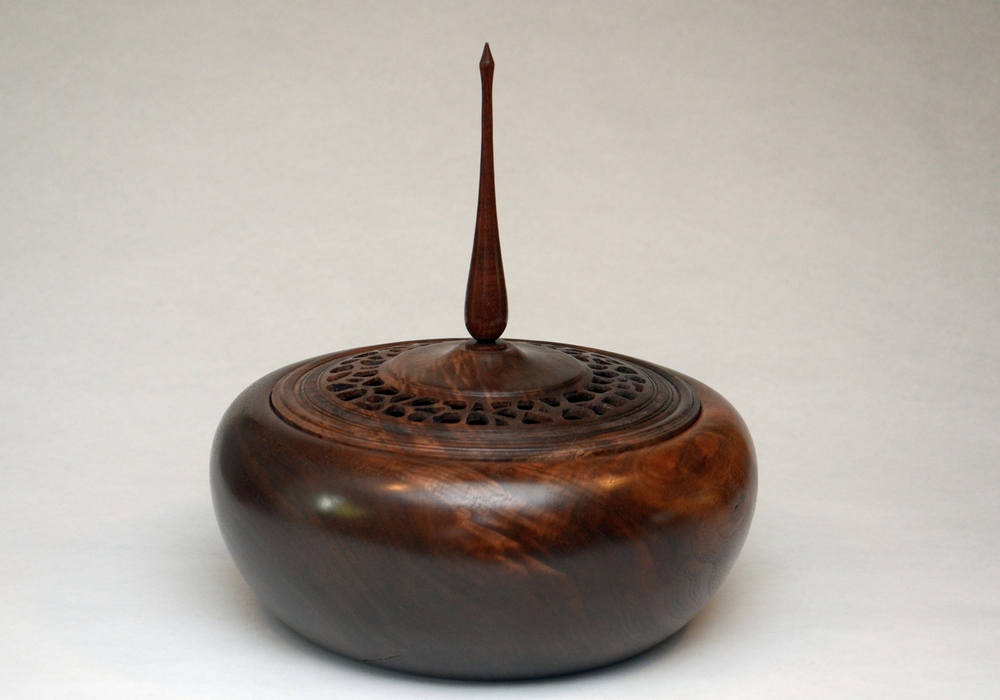
This is a piece of Iowa walnut brought to Texas by a friend, and I started the woodturning in Texas, but completed it in Canada. It was one of the better pieces, and I thought of doing this with it. Again, the idea is not mine as I saw something similar on the World of Woodturners a long time ago, and it stuck with me.

The lid is very fragile, and quite thin to accommodate the random piercing. The entire piece is about 9" in diameter. The bowl is deeply undercut, and about 3/8" thick. I also did something I rarely do, and that was to put some beads in the rim of the bowl. Along with the pierced openings there is a ring of texture on the lid.

Like most of my pieces, this is finished with Danish oil and buffed.>

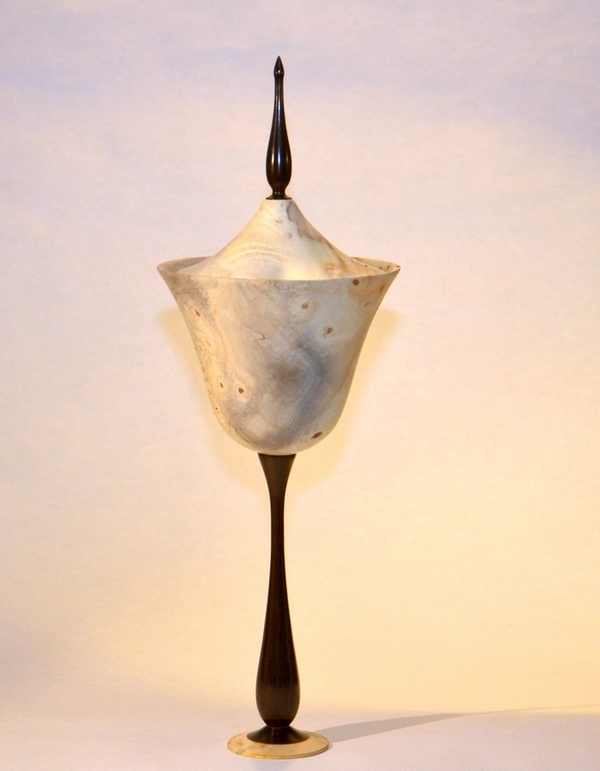
Cottonwood Hollow Form

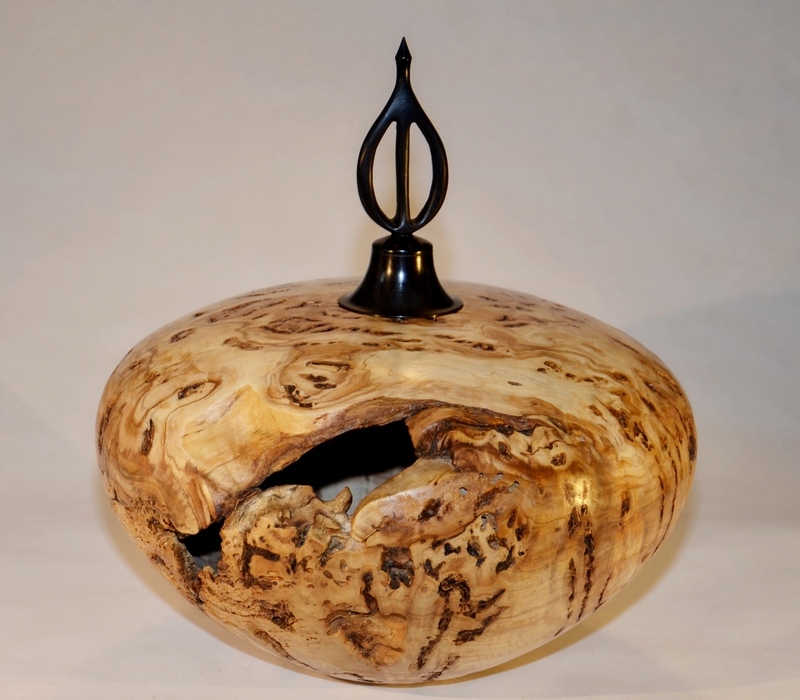
Vern Crandall from Portage la Prairie brought me a large piece of cottonwood burl at a club meeting. His words were, "I want to see what you can do with this wood. It is really strange."

Well, it is strange wood, all right, and this wood was soft and punky in spots and rather difficult to cut. But, I immediately knew what I wanted to do with the majority of it. Since I always try to find a form or shape that will fit the wood and show the wood in the best way, it seemed appropriate that this broad expanse on the top surface would be a good way to show the grain of this unusual and beautiful wood.

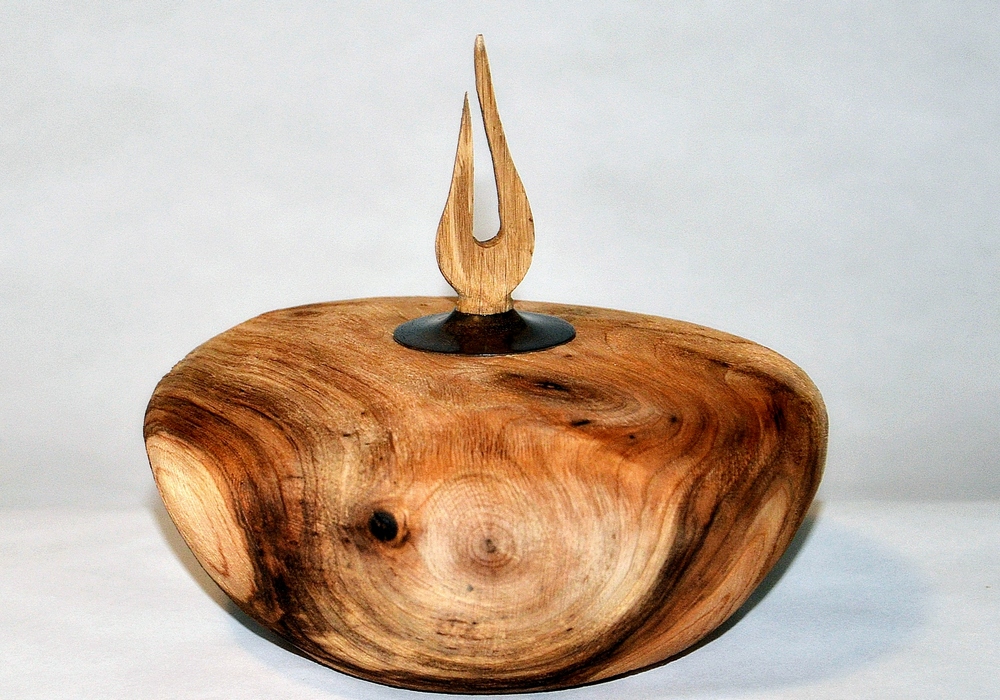
The top piece is what I first came up with. Almost immediately, I did not like it much. I thought the carved and shiny finial did not fit the piece, and the shape of the piece was "off"

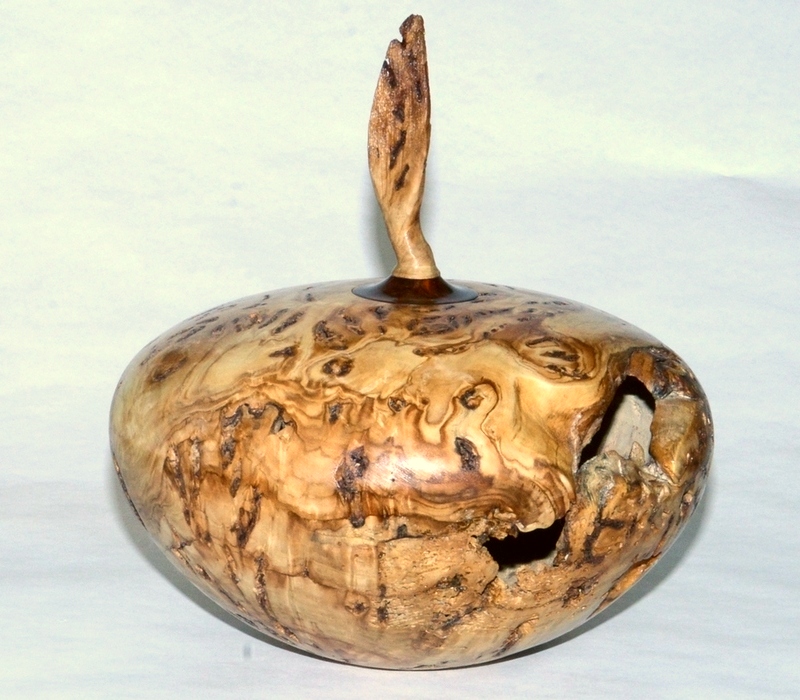
So, after showing it at a club meeting, I returned it to the lathe and change the shape slightly. It is hard to see in the second photo, but the piece was made about ½" shorter which made a nicer flow to the bottom half and reduced the size of the foot. As well, I made another finial, and this time I used cottonwood. As I worked with it, it seemed to me that a feather was developing, so that is what it became, with wire brushing on the feather.

This was then finished with wipe on poly. The piece is 10" in diameter.

Cottonwood Urn

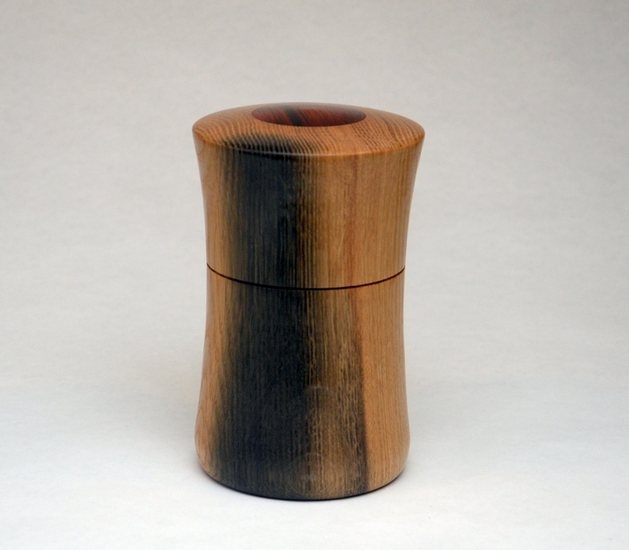
Four boxes here.

I have always like the boxes the Mike Stafford makes, and so some of the boxes will have lids similar to his. Also, with these boxes I try to get a suction fit on the lid, and that is always a bit of a challenge. The one on the top left is like that. It is made of plain old Manitoba oak, which has a uniqueness not found in other oak. Probably because it grows so slowly that it has a very tight, close grain. It is extremely hard when dry, and mostly comes off the gouges as dust and not shavings.

The one on top right is also Manitoba oak, but somewhere close to this piece there must have been a bolt or a large spike in the tree. The black stain comes from the interaction of irion and the tannin in the oak, in much the same fashion that a vinegar and steel wool brew will turn oak black. Anyway, this is natural and sets this piece apart.

The bottom left piece is the same one I posted at the start of this page, and I included it because this is a better photo of the piece. It has an insert of cottonwood on top. You may recognize the shape, as I use this feminine shape a lot on boxes and peppermills and bottoms of vases.

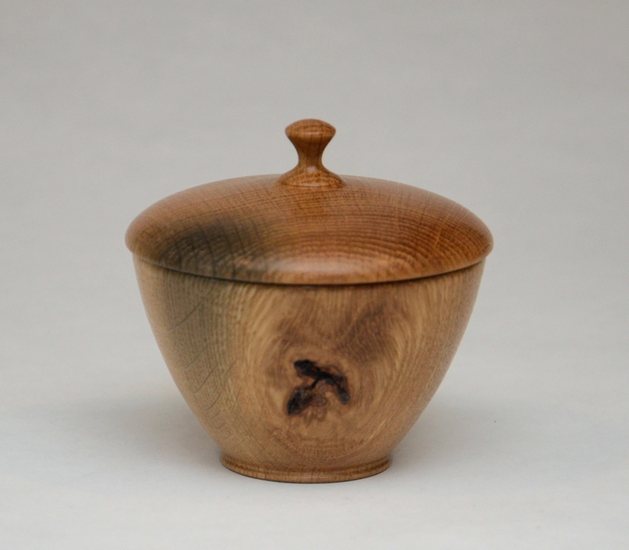
The piece on the bottom right is probably from the same tree as the one above it, and has a bit of the stain left in it. I got these two pieces of oak in a box of blanks from Ed Tabachek, a close friend who died last year, and our club was instrumental in helping his widow deal with the sizable collection of wood and tools that Ed had accumulated.


Oak Box

Spalted Oak Box

Maple Box

Oak Box
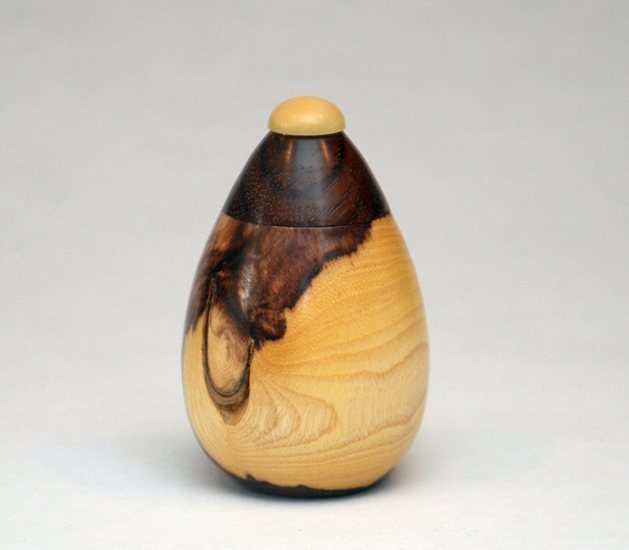
Four more boxes.

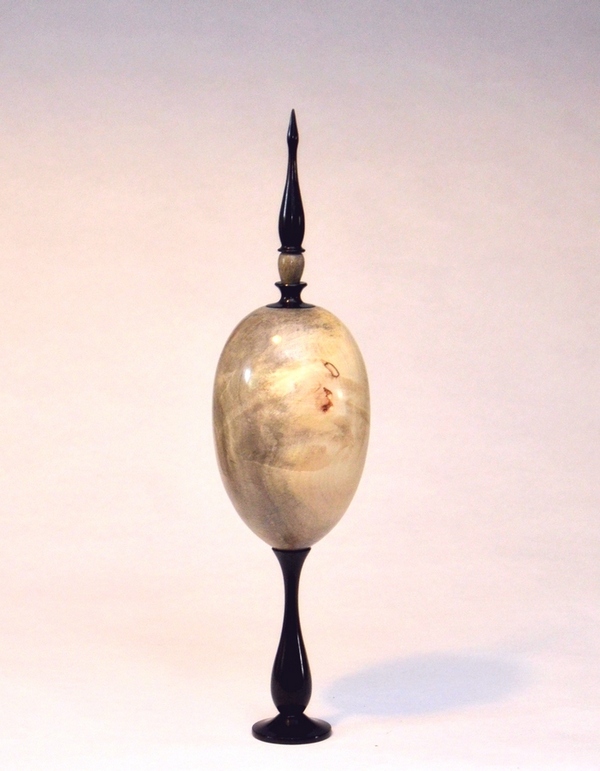
The one on the top left is of a local wood called caragana. It is a small bush, so the pieces are not large, but they have a beautiful creamy color with a dark center. This little egg shaped box has a Texas ebony lid, because Texas ebony is similar in color. The little tip is a tagua nut, which is often used to make tiny little ivory like pieces. Tagua nuts are known as "vegetable ivory". This one yellowed due to the oil finish.

The box on top right is chokecherry with a rosewood handle on top.

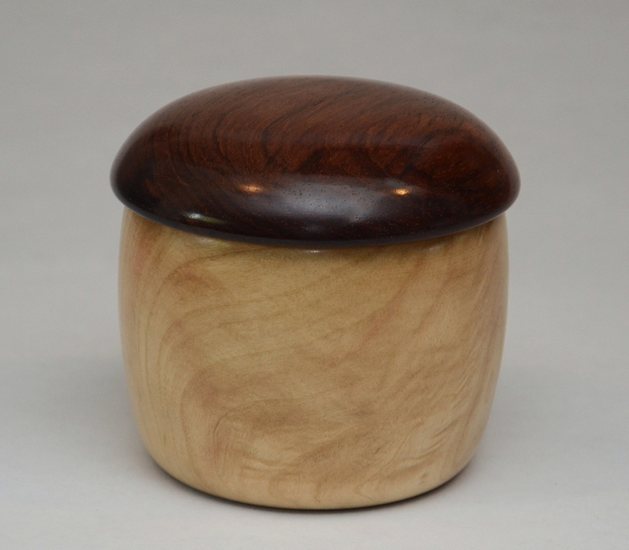
Bottom left is a box of maple with a rosewood lid, and bottom right is a box of oak with a cottonwood insert.


Caragana & Texas Ebony

Spalted Chokecherry Box

Maple & Rosewood Box

Oak & Cottonwood Box
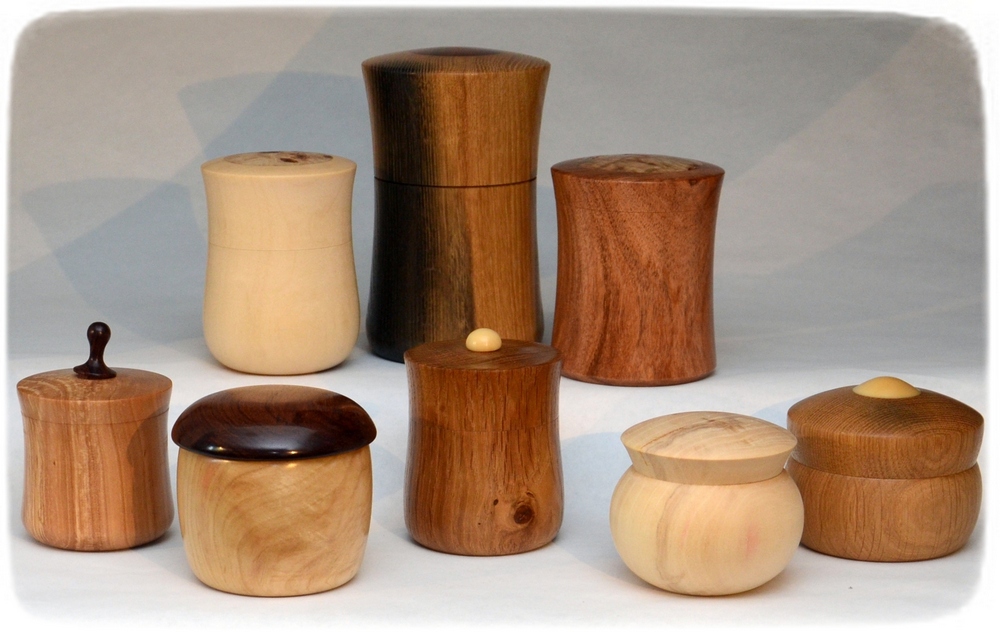
Bunch of Boxes.

Here are all the boxes as a group shot. I included them again as I thought they made a nice little grouping and I could do a fancy kind of border around the photo.

What I did not say in the previous two groupings of individual boxes that these all range in size from 4½" tall to about 2¼" tall for the shortest one. And almost all of them are finished with wipe on polyurethane to withstand handling.

Diamondwood Pin

So, there were four of us as the St. Norbert Famers Market turning in a tent for the public to see and marvel at our turning prowess (that's a joke). Actually, it is a lot fun to do this, since many in the public don't have clue what woodturning is all about. The most common questions are "what is it for?" and "how long did it take you to make that?".

Actually, the general public has no inkling about the skills and time involved. It looks so easy. And, I usually answer the "how long does it take" question with "well, counting the time it has taken to develp the skills and techniques to do this, about 20 years and a few months. If I were just starting out to turn, maybe several days, but it would still not look like this when I was finished."

The public turning is good for our club. First of all, it gets us into the public to show them what it is all about. Secondly, it draws in the young people, and we have turned hundreds of little weedpots and boxes and turning tops and mushrooms to give to the wide-eyed youngsters who watch us. Thirdly, it is a very good education for woodturners to turn in front of someone else, and to answer questions. Every one of us needs a bit of encouragement, and nothing will encourage a beginning turner more than to have someone go "wow" while he/she is working with the wood.

That was a long story to get to the French rolling pins. A lady came up to me at the market and asked if I could make her a French rolling pin using several kinds of wood. I told her to come to my shop and we could discuss it, and I gave her my card. I thought I would probably not hear from her, but she did come and brought two friends with her. She ended up with several rolling pins, a bunch of weedpots and the thick vase shown a few frames below.

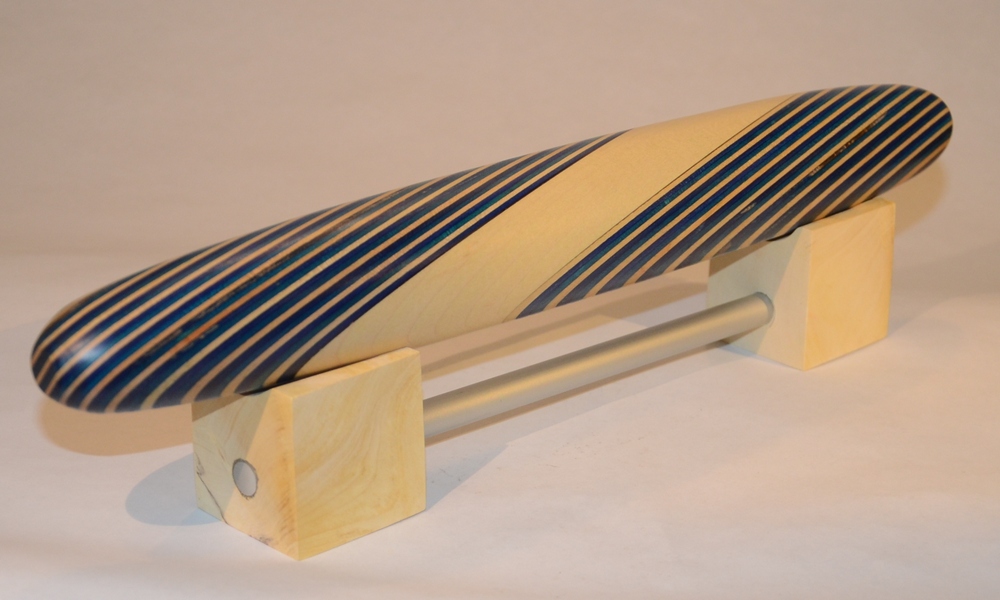
The top pin is made of something called "Diamondwood" and I sandwiched a piece of hard maple in there.

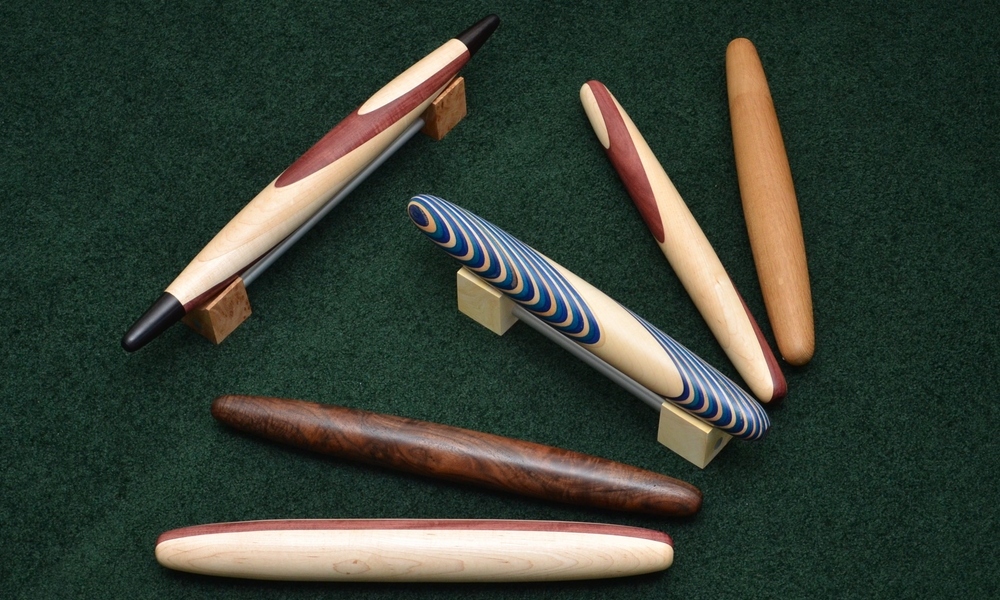
In the bottom photo are, top left - maple and purpleheart with ebony tips, then, bottom to top - hard maple and purpleheart, walnut burl, diamondwood and maple, hard maple and purpleheart and oak at the top.

These are all between 18" and 22" in length and are finished with Tried and True boiled linseed oil. Karen far prefers these pins to the traditional rolling pin.

Have a pin

Walnut Shell Bowl

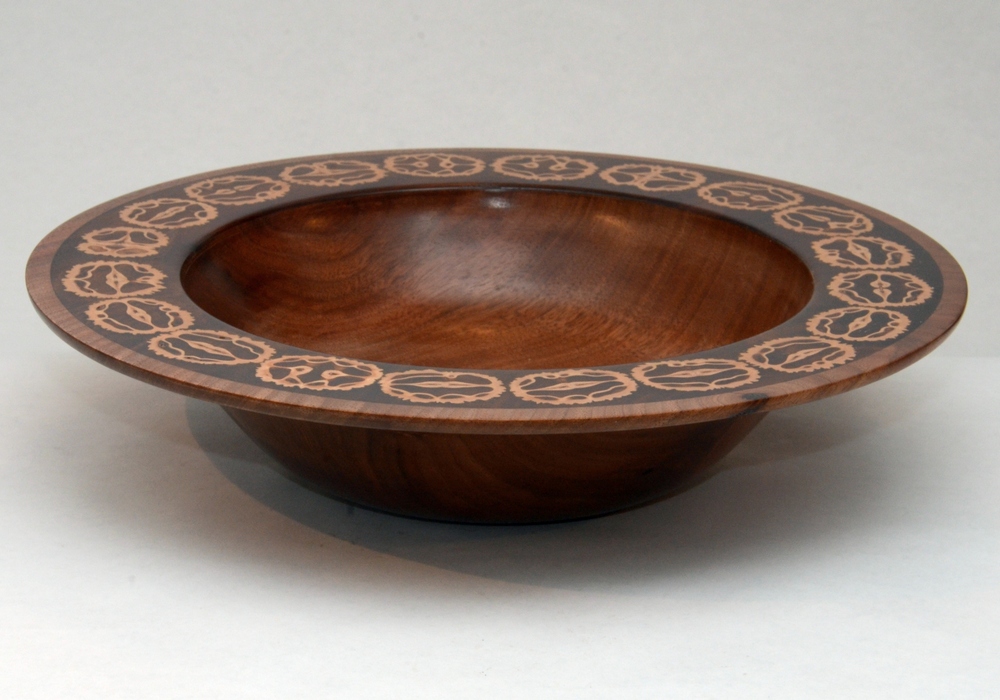
I posted one of these in my 2014 work, and while it is similar, it is not the same. The other one had a groove cut into it and one this one, the innner edge of the groove is missing. The inner edge of the bowl shows the casting resin, and the other one did not. I like this one better.

These are not easy due to the issues with getting rid of bubbles in the casting resin, and the d\ifficculties in cutting the walnut shells. They may look perfect in orientation when they are cast in place, but as they are thinned down, suddenly the orientation turns 90 degress, as is the case with the walnut shells at about 7:00 and 1:00 o'clock on this one. At least they are directly across from one another.

This is 10" in diameter, finished with Danish oil.

Natural Edge Thick Vase

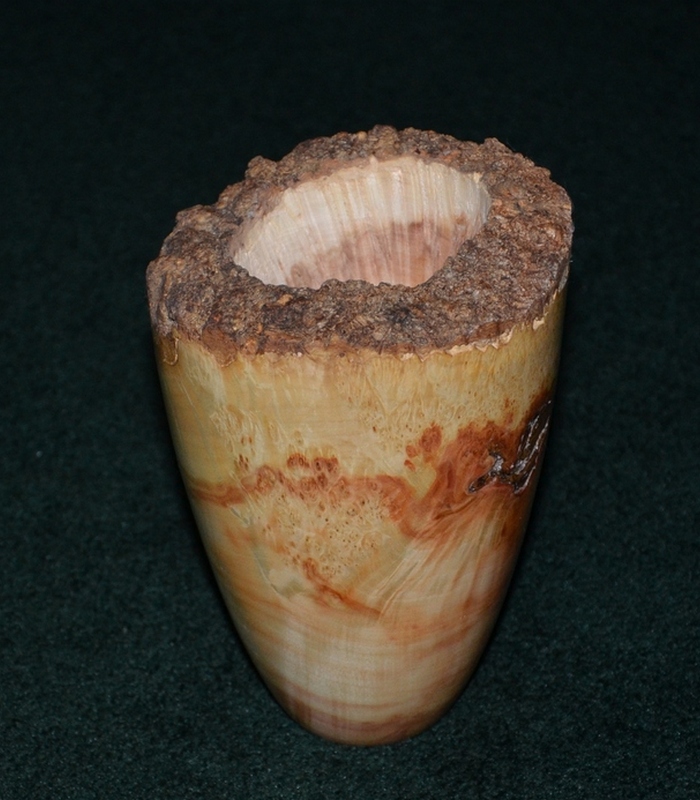
When the lady came to get one of my French rolling pins, she was immediately taken by this rough piece on the bench of my shop.

I told her it had been there for several years and I had just not gotten around to finishing it. She said, "It reminds me of my husband, all rough and thick looking. I want it.".

So we agreed I would finish it, leave it thick, and leave it rough. I made the outside smooth, but the inside I roughed up as much as I could with the Termite tool, and left it unfinished. She loved it and took it home. I have no idea if her husband liked it.

This is Manitoba maple, about 10" tall.

Wonky Urn

This is chokecherry, turned green (wet) and left to dry. Like most fruit woods, it warped and twisted badly, and when my friend Al Stewart came into the shop, he said he wanted it, warts and all. .

So I told him I would finish it, and I completed and polished the inside, leavingthe outside as it was. Except I wirebrushed it to give it a very textured exterior amd added a wirebrushed flame finial on some polished ebony.

The piece is 8" in diameter, and is finished with Danish oil, but not buffed.

Canada Day

Every year in our park in Texas we have a "Canada Day", even though the real Canada Day is July 1 of each year. Doesn't matter - all the Canadians get together and celebrate Canada.

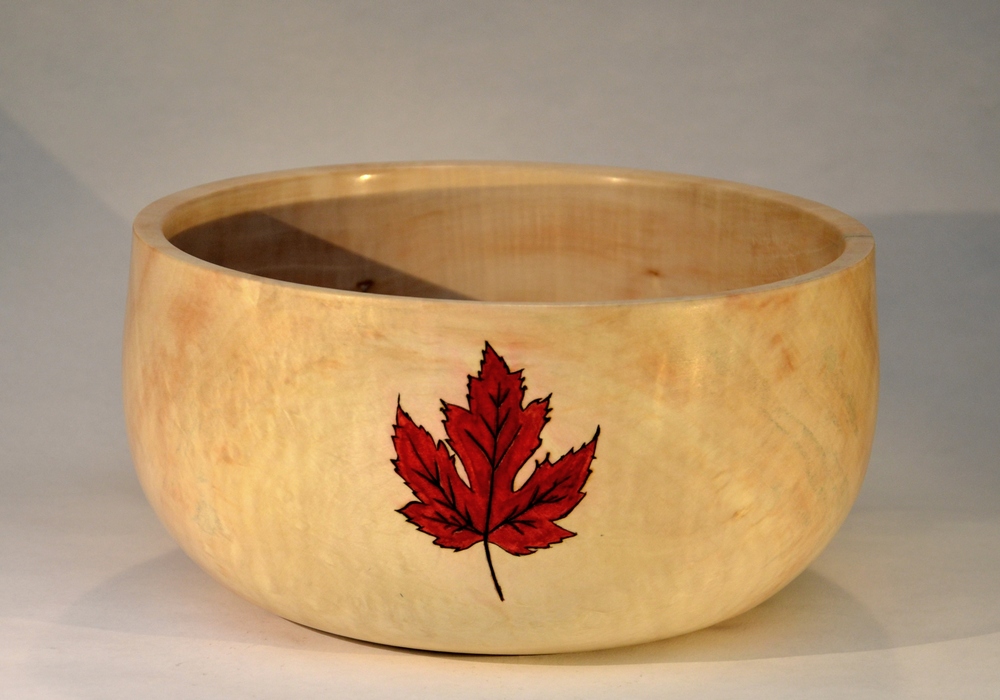
I was asked to make a bowl for a door prize, and I chose Manitoba maple, and decided to try a calabash form. The calabash form is extremely difficult to achieve just right, and before I finished this I posted it on the World of Woodturners and asked the Hawaiians if I had got the form right. They said I nailed it. It has to have just the right curve, and a slight backward curve and a straightening out just below the rim.

With their blessing intact, I then etched and burned a maple leaf on to the form and colored it with three different Prismacolor pens to get the right shading.

To ensure the bowl is truly Canadian, I inscribed it on the bottom with, "Herman de Vries - eh?"

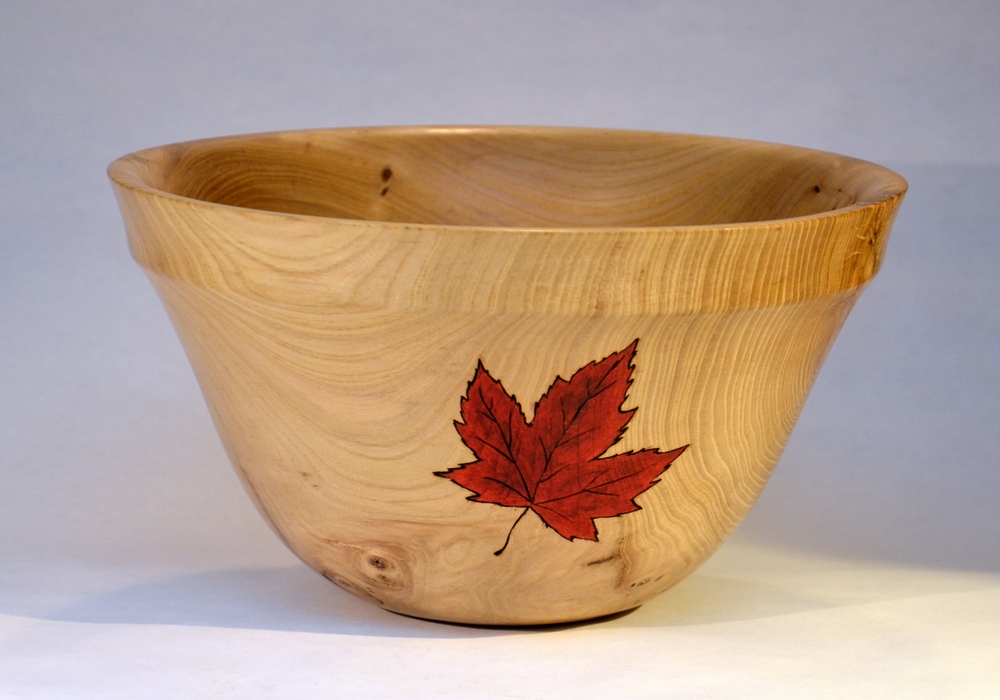
The lower one is a second bowl I did, and Karen said she like it, so we still have it. It is made of elm.

Both bowls are about 10" in diameter.

Canada Day

Classical Urn

"Bones" - what a strange name.

Wait - there's an explanation! You see, inspiration and ideas come from all over, and when something strikes you it is worthwhile to take note.

I like the wonky TV show called Bones, and while watching the show there was a scene in Bones office. In the background on her shelves was a number of vase and urn forms. I liked them, so I hit pause and took a photograph of the TV screen. Thus, the name.

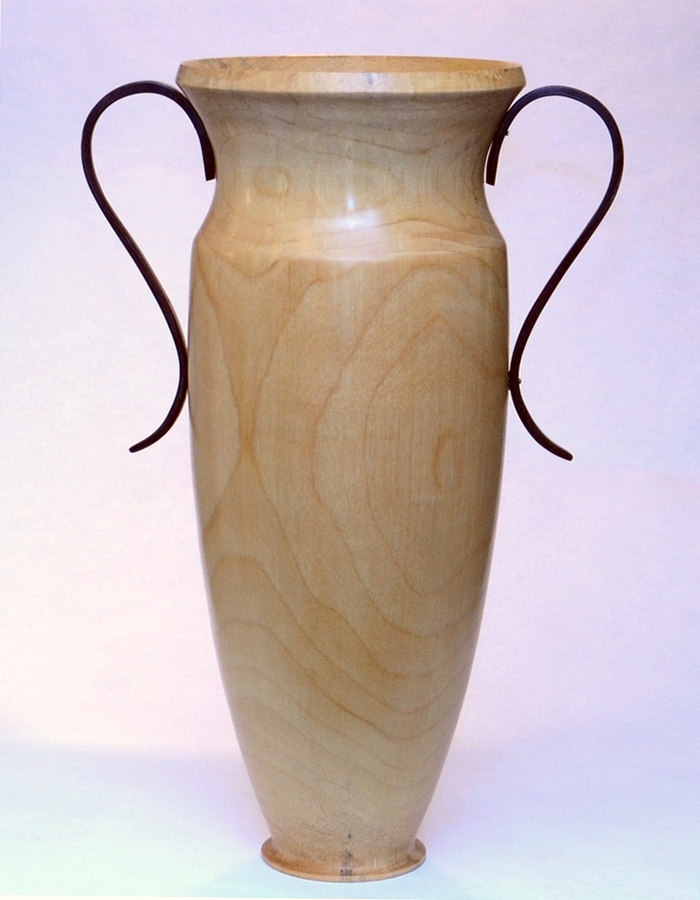
This 15" vase is made of maple, turned very thin. The handles are of "compressed wood" (look it up), which is wood that can be cut and bent without steam or heating, into any shape at all. I have tied knots in it.

The handles were bent from compressed walnut, set in place with heat, and then sanded and finished before mounting. They are mounted to the piece with tiny dowels that do not go through either the handles or the walls of the piece. This was hard to do.

It is a classic shape, the first one I ever did, and I have a couple of others on the drawing board.

Buckeye Pedestal Form
Buckeye Lidded Goblet

I think buckeye is one of the most beautiful woods around. A number of years ago, Lionel Bedard and I got together on a large order of buckeye and other woods, and he sent me a pallet of wood. I, in turn distributed much of the wood to people in my club.

I mentioned previously that my friend, Ed Tabachek, had died in mid 2014. When Joanne and I were going through some of the wood that Ed had, there were a few pieces that I recognized right away, because they had my handwriting on them. Some of that wood was the buckeye that he had originally gotten from me and never processed. So, I got it back, and these two pieces are part of what came from that stash.

The top piece is another of those forms and styles that I got from pieces I had seen on WoW (World of Woodturners). I thought this wood would lend itself well to that style. Maybe at some point I will get a better photograph of this piece. It is very light, very thin, and about 10" tall. The form is replicated in miniature in the finial of the piece. A tiny dowel runs through that form to join the three pieces together. This is finished with sanding sealer and buffed.

The second piece is a lidded goblet, and I have done several of these in the past. It stands about 12" tall, and is finished with matte Krylon finish. It is very light and fragile. The stand and finial are ebony.

Bunch of Weedpots

Earlier, I mentioned that the lady who got some of my rolling pins had come with some friends, and they took home some weedpots.

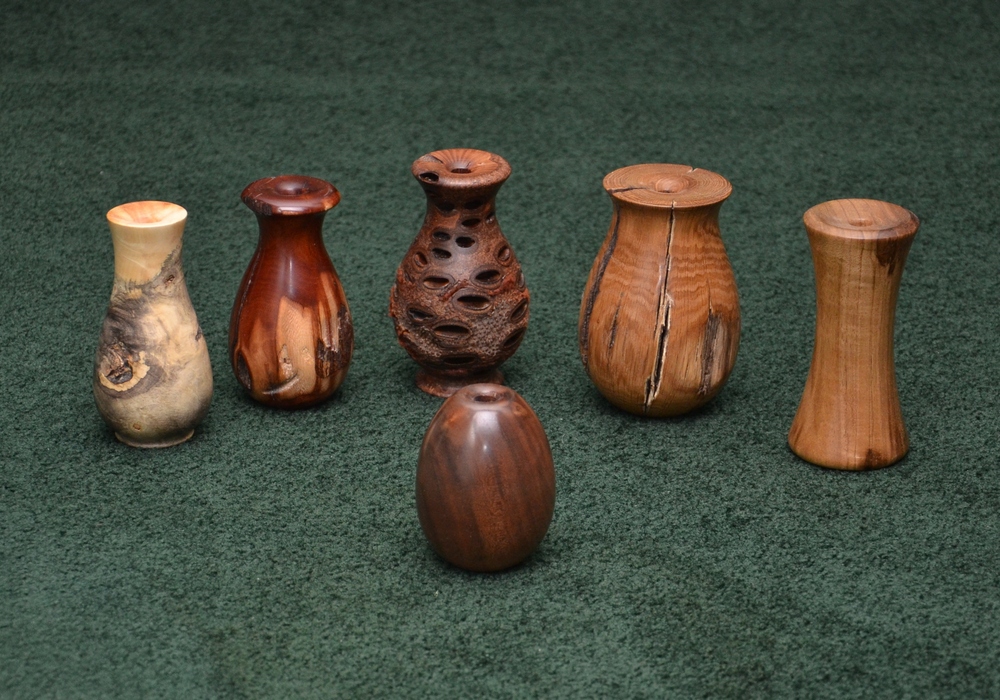
These are weedpots, and they are a terrific teaching tool. I try to get my students to turn all kinds of shapes and make them into weedpots. There is a reason for this.

You see, it is hard for people to just turn for practice - to turn a log into a toothpick just to practice using the tools. The weedpot presents an alternative. First, it does not take a lot of wood. Secondly, one can experiment with all kinds of shapes and develop a feel for the shape that suits them. Thirdly, the muscle memory needed to turn a large form can be developed turning these small forms. They are a terrific learning tool.

These are, left to right, buckeye, desert ironwood, banksia pod, oak, cherry, and in front, Texas ebony.

These are all between 2½ and 4" tall.

Weedpot family

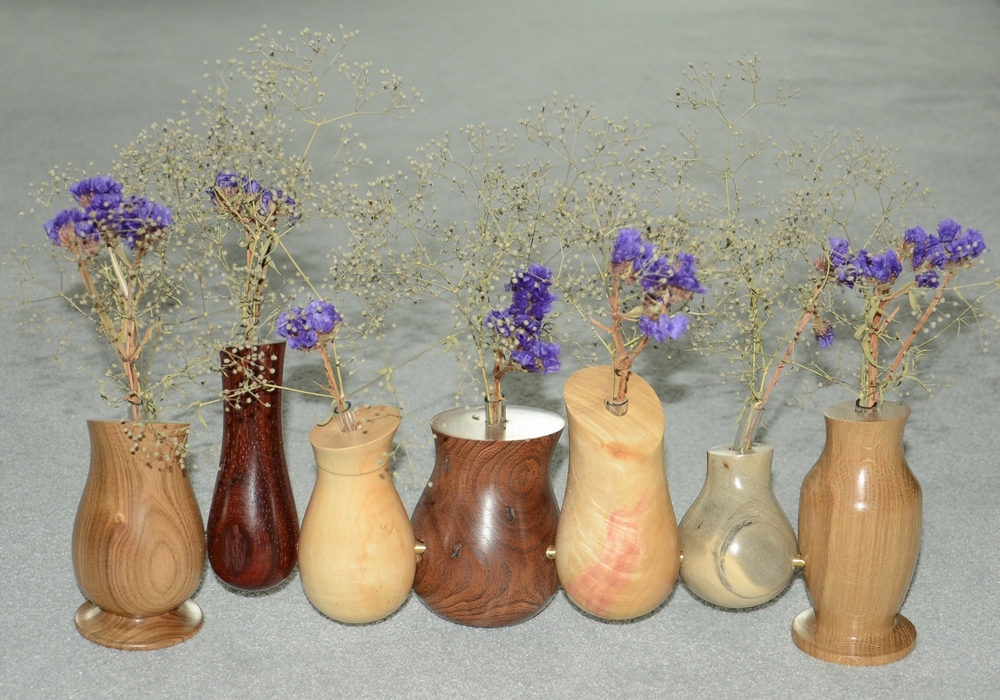
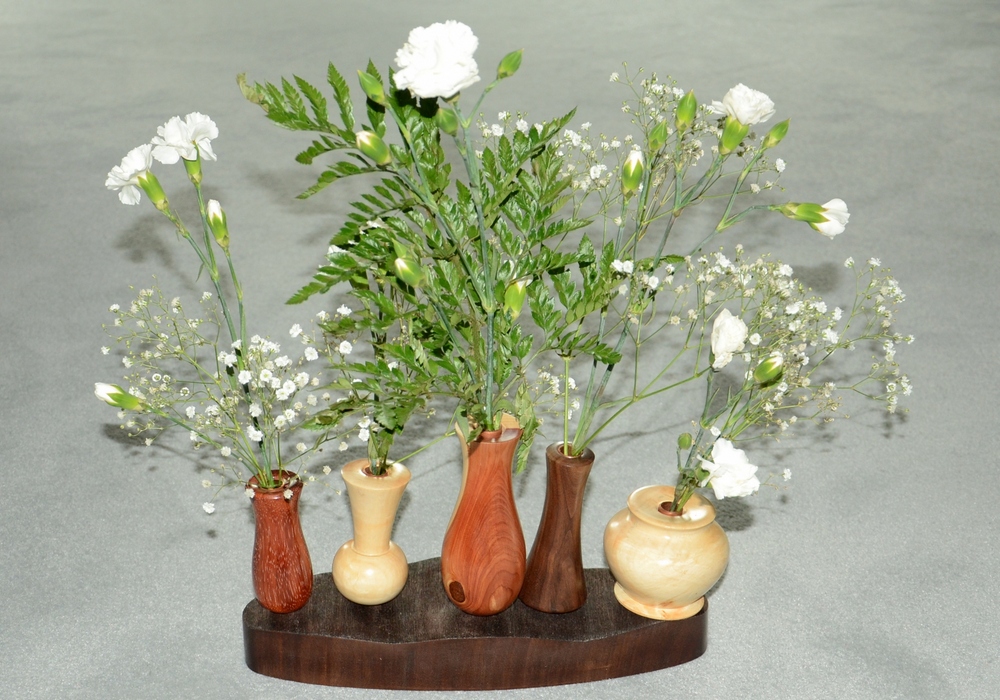
I posted a photo of the weedpots in the upper panel in my work of last year. In that instance, they had real flowers in them, since the little tubes in the pots are sealed on the bottom and can hold water for real flowers. In this photo, they have dried flowers in them.

The bottom one is a bit different. Each pot has a dowel protruding from the bottom and the dowel fits into a hole in the base (which is made of dyed and wirebrushed walnut) I gave the top an uneven surface before wire brushing.

There are several other weedpots that go with this set, so the pots can be altered and changed around to fit what you want to put in them. These are also fitted with sealed copper tubes to hold water for real flowers.

Weedpot family

This is a teaching opportunity.

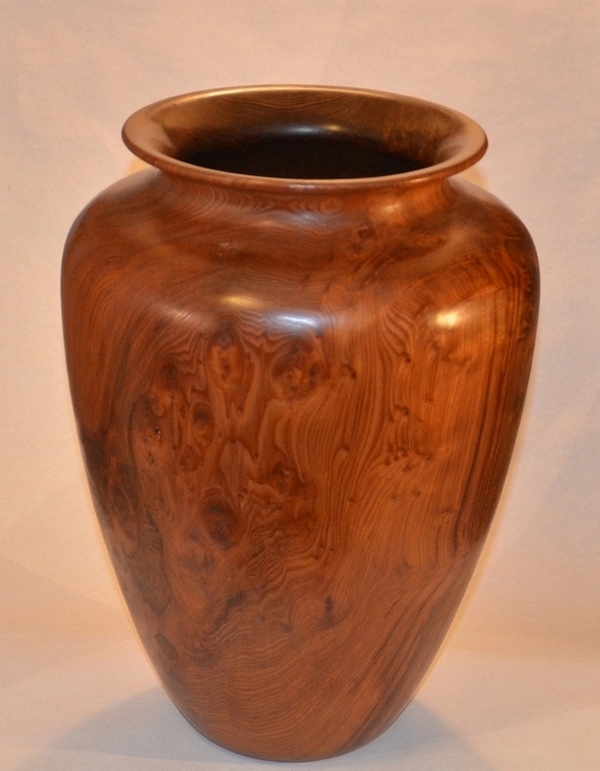
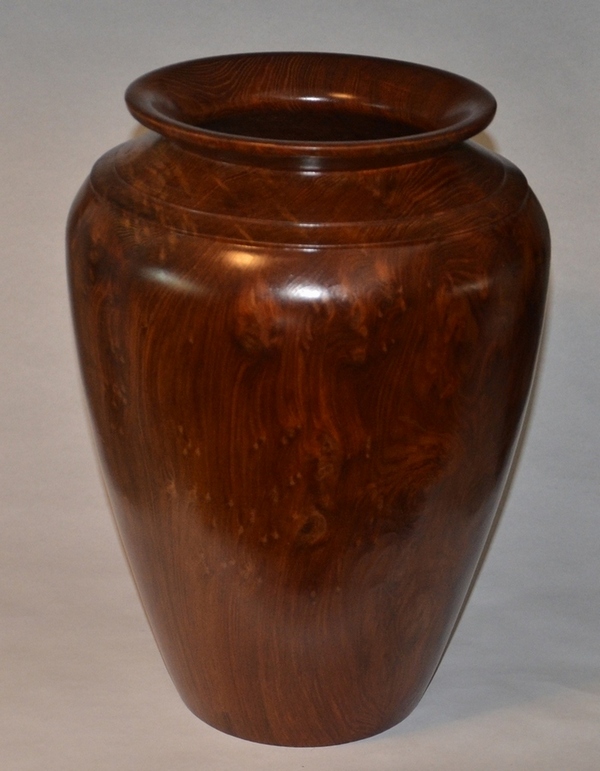
The vase on the right was first turned in 1999. It is redwood, about 20" tall, and it sat on a pedestal in the foyer of our home ever since it was made. The problem was, the longer I was involved with woodturning, the more I disliked the way the piece looked.

So, this year, when Karen was out and could not stop me, I dragged the thing back into the shop, re-mounted it on the lathe, gave it a new tenon on the bottom and then completely re-turned the outside. I took off the awful bead on the top, gave the lip a consistent sweeping U-curve instead of the V-curve it had before, and took a lot of material away from the bottom. The reduction of the diameter at the base and "tucking under" the base creates a shadow line where it sits on the table and creates "lift". Without that, like the old piece, it looks like it is growing out of the table instead. Additionally, there are "flat" spots on the form of the old one, and the new version has a continual sweeping curve from top to bottom with no interruptions and no flat spots.

This piece of old growth redwood burl cost me more than $400 originally, so it was a bit of a risk to re-do the piece. However, it was well worth it as the new form is vastly superior to the old one. Even Karen agrees.

The color is accurate on both photos. The old version had 14 years of darkening and patina on it.


Redwood vase

Redwood vase old
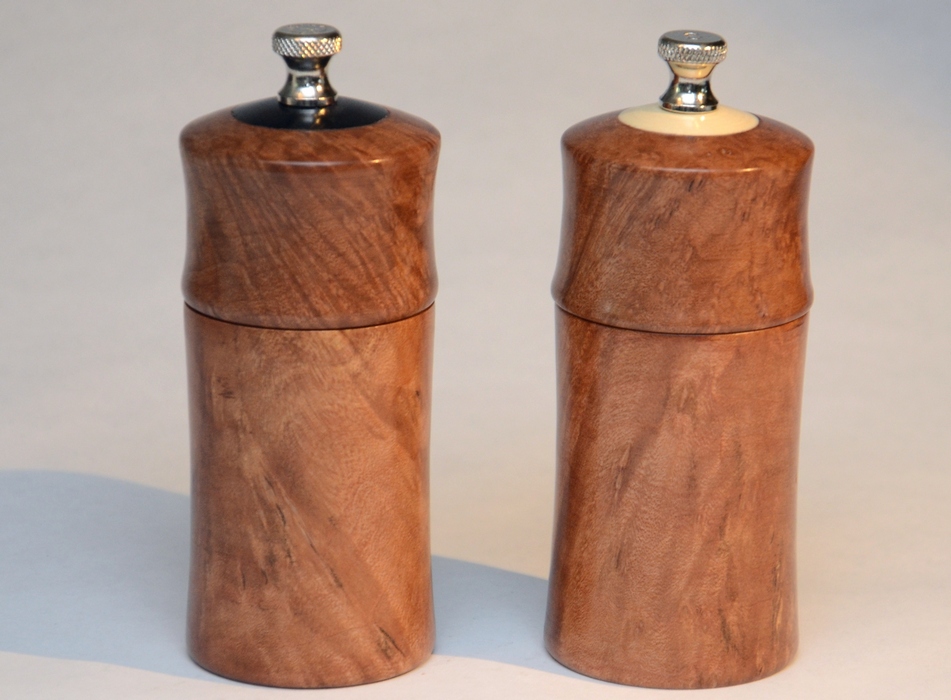
Madronne Pepper & Salt Mills

Some years ago, I turned some little salt and pepper mills for Karen's kitchen table, out of banksia pods. They were cute, but when I showed her these she said she wanted them for her kitchen and I could get rid of the banksia mills.

So, that is where they are, in our kitchen for use with daily meals. About 4" tall and finished with wipe on poly.

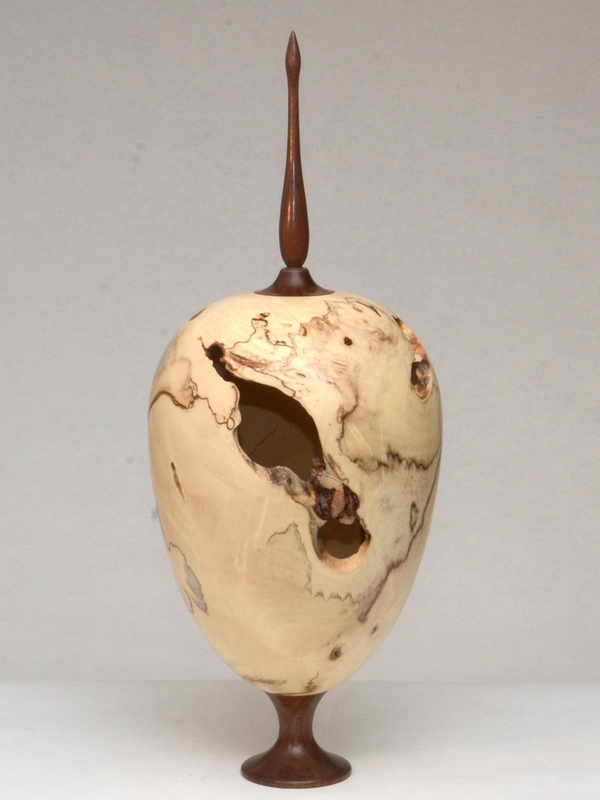
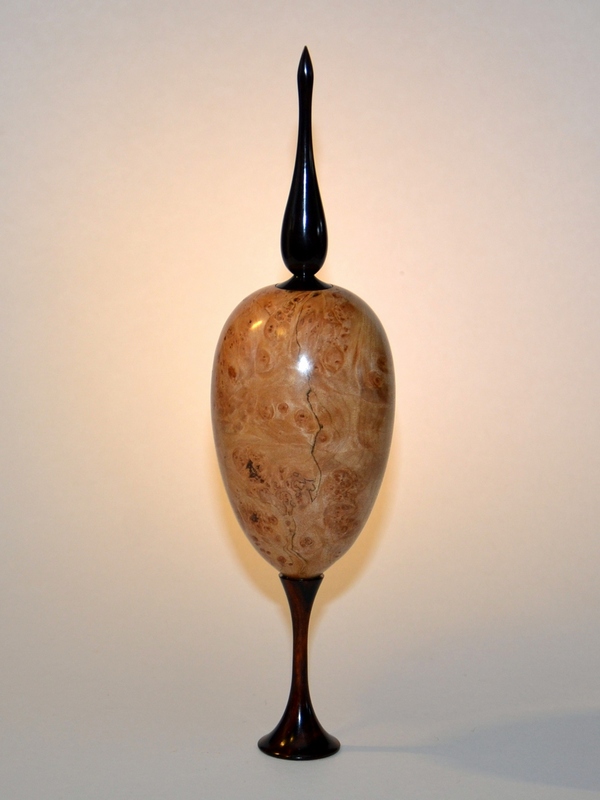
I made a few of these pedestal hollow forms this year, and will continue to work on my technique in making these. They are graceful and beautiful forms to attempt

The form on the left is from the buckeye I got back from Ed Tabachek, and this one I like very much. It was fun and difficult due to the voids in it, and it is turned quite thin, about 3/16". It stands about 11" tall overall, and is finished with matter Krylon spray finish. The base and finial are made of walnut.

The one on the right is turned of big leaf maple burl, and stands about 9" overall. The base and finial are made of ebony.


Buckeye Pedestal Hollow Form

Maple Burl Pedestal Form