I just finished the web page for 2003 - yeah, it's February of 2004 - and now I've already got a start for the 2004 pages. Hmmmm - I think I'll start on 2005 about November.
I've started out the year with some pretty small items, although a 26" vase is on the lathe as I write this. A good friend, Helen Waldby, sent me a couple of pieces of wood from Australia. They were roughly 4" by 2", so I decided to spin a couple of small lidded hollow forms. One was of jarrah, and the other was of sheoak.
While turning the two little forms, I discovered I liked turning small. So, I went out and bought some more exotic woods to turn a few more. Some of them will be posted on this site.
I also started turning some small lidded egg shapes, and I hope later this year to get started on using burning and coloring on my pieces. I guess you will have to re-visit to see if I follow through.
Enjoy the work. Again, thank you for visiting, and please let me know you were here.
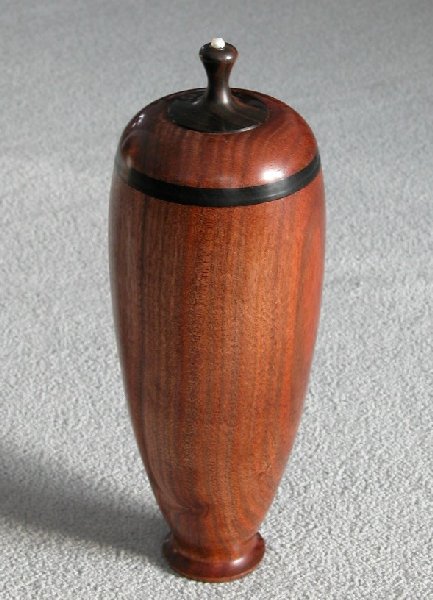 |
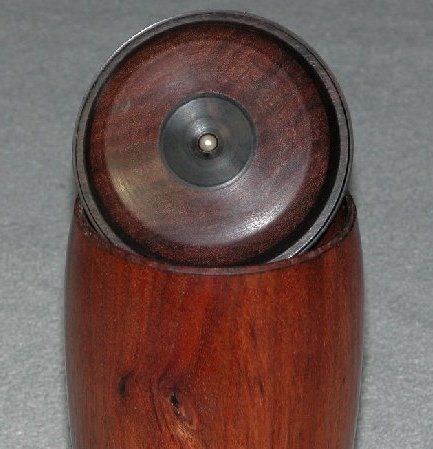
I am not totally sure about the wood, but I think it is the piece of black acacia that was given to me by my friend Brad Adams when I was at the Woodturner's Symposium in Pasadena last fall. If I learn differently, or if anyone out there recognizes the wood, I will change the type.Regardless, it is about 12" tall and 4" in diameter. The finial is of ebony. When I finished it, I thought it needed something extra, so I went to the jewelers store and bought two pearls. One was placed in a small hole in the tip of the finial, and the other into the middle of the top on the inside. The bottom photo shows the vase with the lid off. You can see the pearl on the inside. The vase took on a beautiful finish of Deft Danish oil buffed with the Beall buffing wheels
|
||
 |
|||
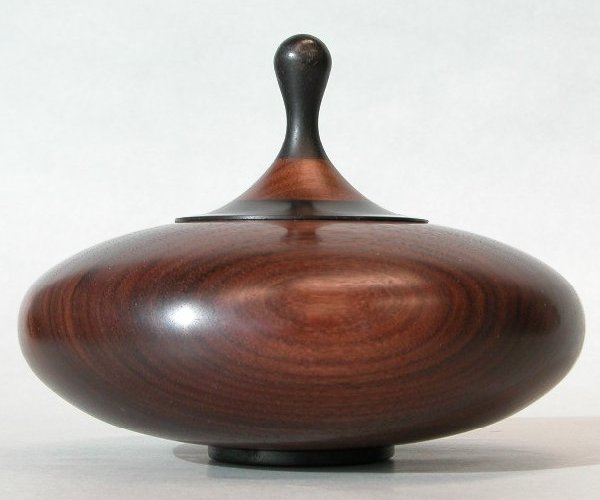 |
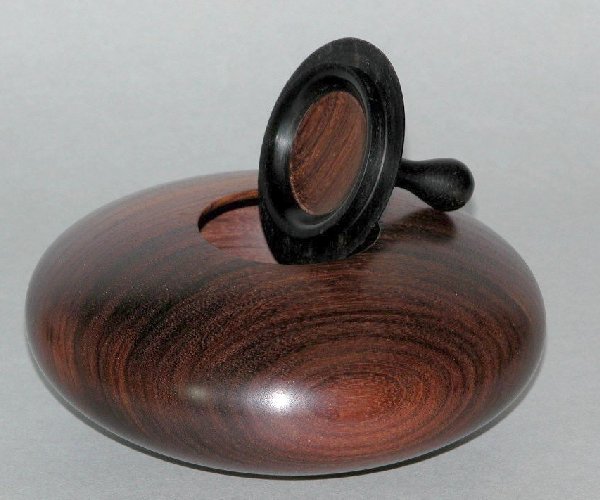
This is the third small lidded hollow form I turned. It is about 4" in diameter and about 2" high without the lid. The finial makes the piece about 4" high as well.It is made of rosewood with an ebony finial and a little ebony foot. The piece was turned through a hole in the top about 1¼" in diameter, and is about 1/8" thick. The base was left a bit thicker to provide stability. The bottom photo shows the form with the lid open. You can get a good idea of the thickness of the wall of the piece. |
||
 |
|||
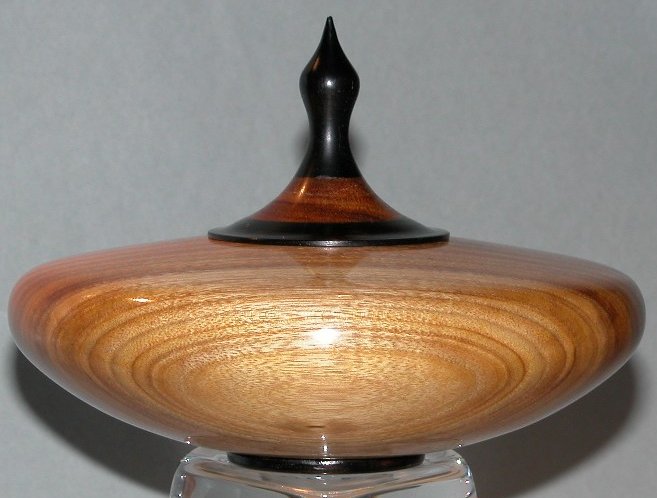 |
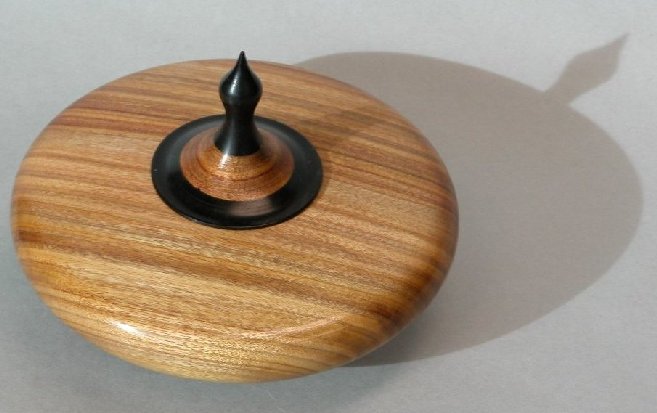
This canarywood form is another of the small hollow forms with lids and ebony finials. This one is about 5" in diameter and about 4" tall including the finial. It was very interesting trying to get the wall thin at the widest part of the form.I am showing you a second view, taken from above, so you can see the lovely grain of the wood.
|
||
 |
|||
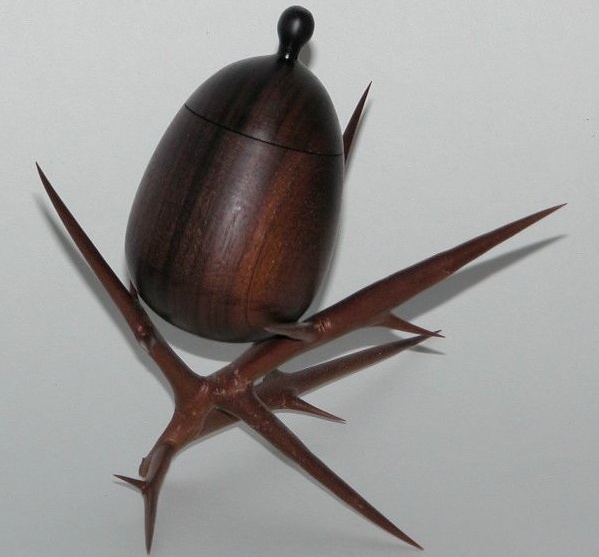 |
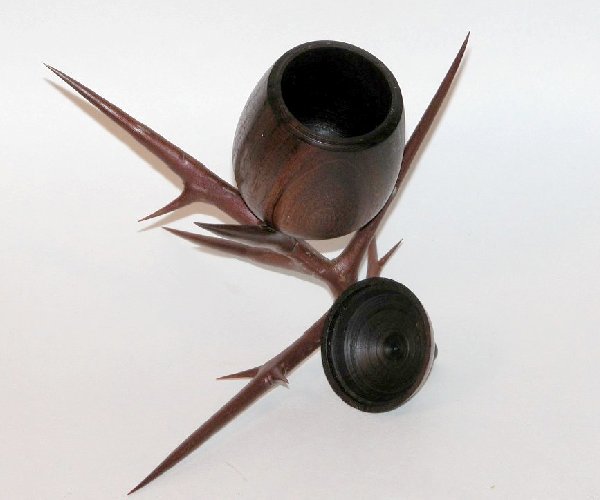
This little jewel is of rosewood and it is merely 2" tall and about 1" across. The finial is of ebony and is 3/8" tall. I think it probably looked funny to be turning this tiny little piece on a big General lathe. Why is the egg in trouble? See where it's sitting? Well, those thorns are from Jamie Donaldson, who lives in Texas. Haven't you heard that everything in Texas is big? These things are WICKED. The bottom photo shows that the tiny egg too, has a lid. |
||
 |
|||
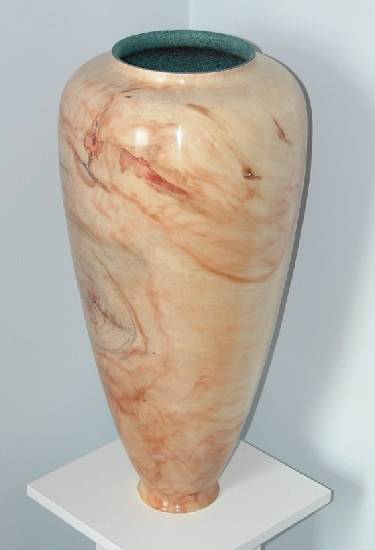 |
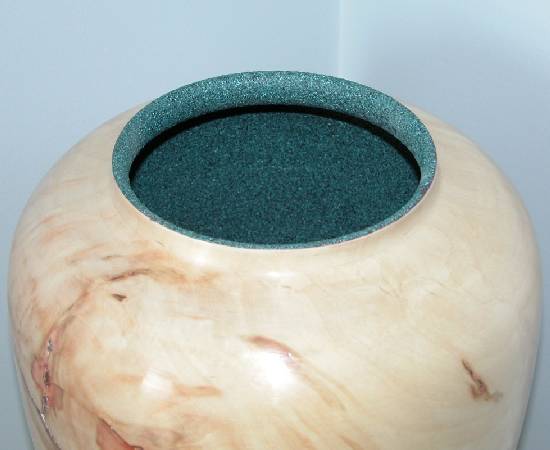
I have always liked turning large pieces, and when Mike called and said a large Manitoba Maple tree was available if we wanted it, I couldn't grab my chain saw fast enough.The blank for this vase weighed close to 175 pounds, and it was some fun to hoist up onto the lathe all by myself. This kind of weight spinning inches from your face at 300 rpm will make you approach it very carefully with a razor sharp chisel. If you would like to see a series of 26 photos showing the process of turning this vase, here is an Adobe file "Turning a Large Vase" that you can view. Just right-click on the link and "save target" if you want to download the file to your own computer. At any rate, the upper photo shows you the finished result. A vase about 24" in height and 12" in diameter. The walls of the vase are about ¼" thick. It is finished with water-borne urethane, mainly because that will protect the colors from fading, and it is extremely tough. I finished the inside with spray-on texture paint. The sheer volume of surface on the piece was almost overwhelming, and I was looking for an effect that break that up and set the piece apart. While walking through Canadian Tire, the Krylon "Make it Metal" paint must have registered in my subconscious, because I woke up in the middle of night knowing what I would do. The bottom photo shows a close up of the texture paint job, and I like it because green (well, teal) is one of my favorite colors.
|
||
 |
|||
 |
 |
|
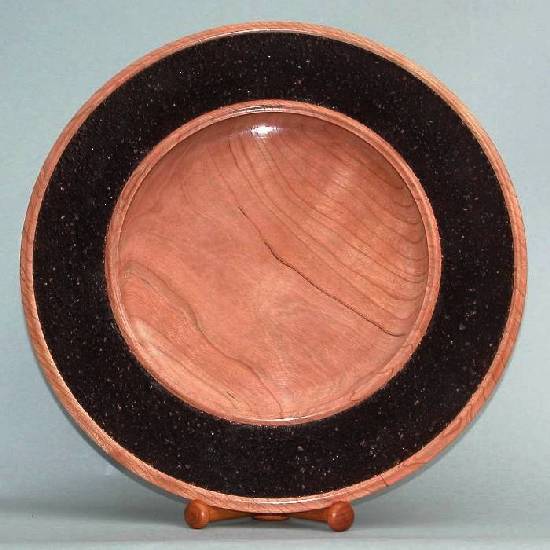
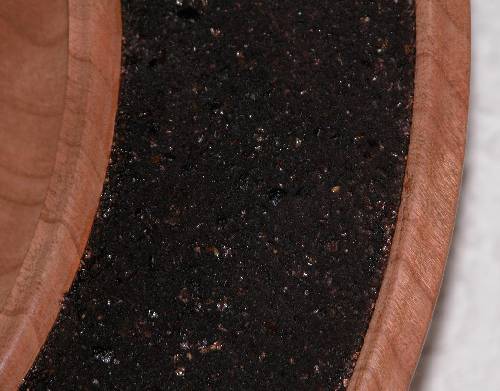
This one is a bit of an experiment. I had read of people using coffee grounds to fill a knothole or create fake bark, and I thought it might look good used as a texture on the rim of a big platter. I had a big log of this cherry, and turned five pieces out of it. The cherry is such a wonderful wood to turn, and smells so nice when you turn it. This platter is one of two (the other follows) and was fun to do. I think the coffee worked out extremely well (and it smelled so good), but unfortunately I could not leave it alone. I did not like the shiny highlights in the coffee texturing, so I tried to use a matte finish to dull the shiny spots. Well, to tell the truth, I ruined it, and as I write this the cherry platter sits in the shop waiting for me to re-mount it on the lathe and spin it to scrape off the coffee and re-do it. Hopefully, I will be able to do that. The platter is about 13 inches in diameter, and is finished with urethane, wet sanded and waxed. The photo in the right panel shows the coffee texturing up close.
|
||
 |
 |
|
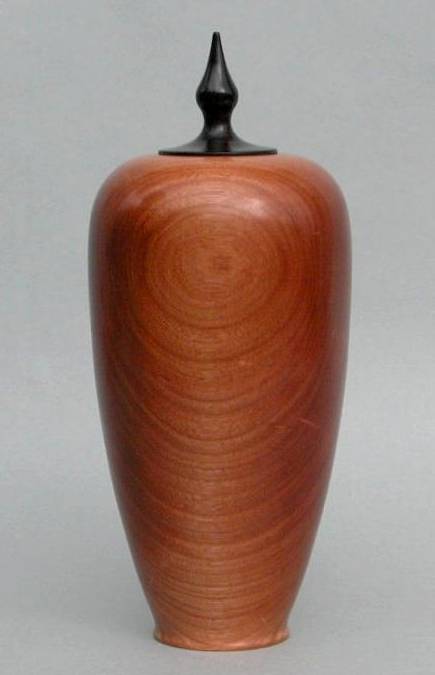
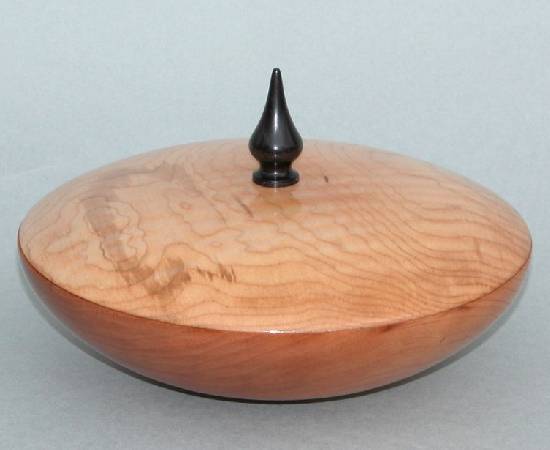
Believe it or not, these are urns. Not full size, but more commonly know as "keepsake urns". A friend's father passed away and I made three of these small urns for him, his son and his sister. Each will have a small amount of ashes in them, and the remainder will be scattered. The urns are coated with epoxy on the interior to make them impervious, and after the ashes are put into the vessels, they are epoxied shut. The tall urn is about 9 inches tall and 3½ inches in diameter. The dish shaped urn is 7½ inches in diameter and 3 inches tall.
|
||
 |
 |
|
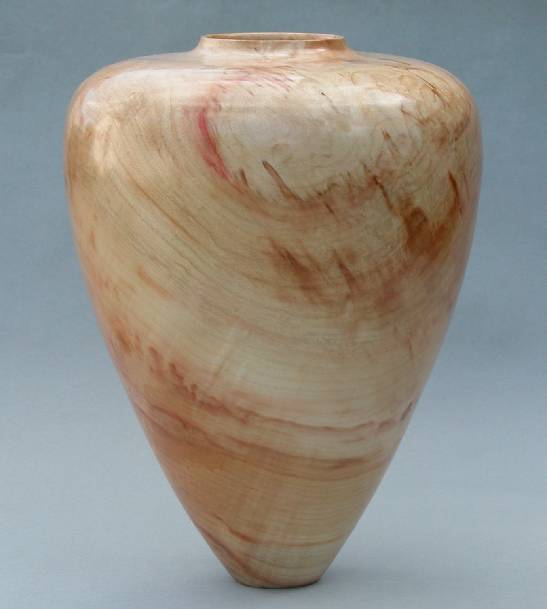
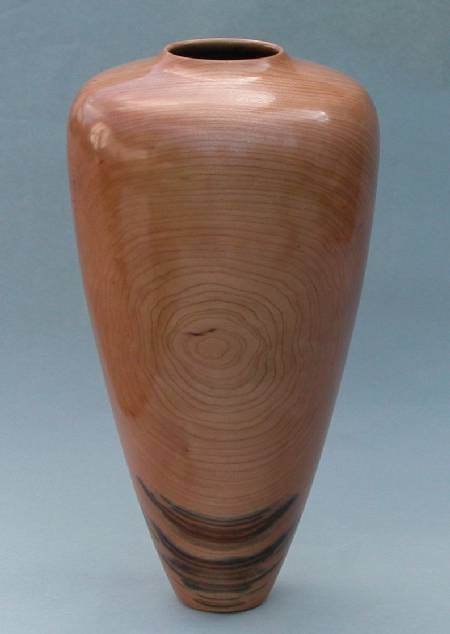
The Manitoba Maple Vase on the left is called "Mister Manitoba", due to his broad shoulders and very slender waist. The name was suggested by Karen, as she thought he was rather masculine looking and, of course, he is of a Manitoba wood found right here in Winnipeg - in an area of the City called North Kildonan. Mr. Manitoba is BIG. He stands 13½ inches tall and is 9 inches wide at the shoulders. He has a finish of water borne urethane, wet sanded and buffed for a lonnnng time The tall cherry piece on the right is called "Toonie Surprise". The reason? Turn her over and she has a "toonie" - a two-dollar Canadian coin - embedded in her base. The cherry wood stands on its own, and did not really need the toonie except for a reason that only a woodturner would understand. If you really want to know, you have to email me and ask. The wood is especially nice due to the mineral stains toward the base. I will also leave it to woodturners to guess how I oriented this piece of wood to get the grain design in the side like that. The piece is about 14" tall and 6" in diameter. It is finished with Danish oil and buffed. Both of these pieces are very, very thin and are very, very light in weight.
|
||
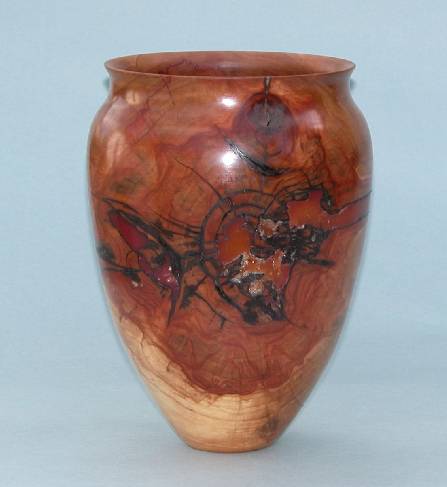 |
Bernice said, "Why is that turning in your firewood box?"I took the hunk of broken and rotten apple wood out of the box and showed her how it was falling apart and looked just awful. She said, "Herman, I'm surprised that you wouldn't think of something to do with that." Well, that was a challenge if I ever heard one, so I dragged the ugly thing back into the shop where it sat for a year or so. I finally decided to fill the large cracks with fiberglass resin, colored burgundy and orange, with gold glitter in it. Then I turned it, and what came from that piece of garbage is what I have decided to call "Junkwood Jewel". It has become a favorite of mine, as it is representative of what can be accomplished with something that is discarded when the right amount of love, care and imagination is applied to it. I hear it works with people, too.
|
||
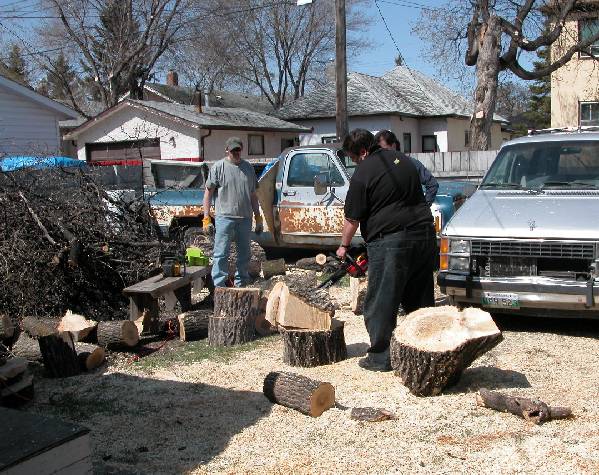 |
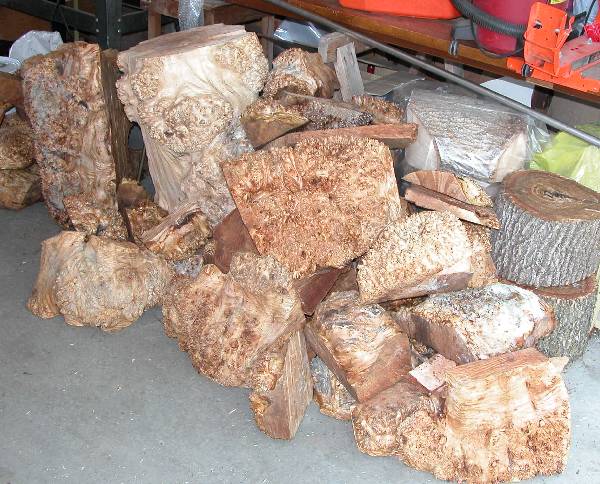
People always ask, especially woodturners, "Where do you get your wood?"Finding a steady supply of nice useable wood is a challenge (although the previous piece shows it doesn’t have to be pretty to be useable). And then, it's usually feast or famine. One time I will have more wood than I know what to do with, and have trouble finding time to turn it, and the next time I am out scouting around for wood to turn. That's why, when someone calls and says they have taken a tree down and do I want the wood, it is really hard to say no - especially if the wood is nice. If it is burl wood, it is impossible to say no, and I would be crazy to say no. So, when I was told about a back yard full of pieces of a big maple, I called some friends and we spent a happy Sunday afternoon with our chainsaws keeping everyone in the neighborhood awake (they shouldn't be sleeping on a nice Sunday afternoon anyway). Only three of the guys, Mike, Murray and Paul Martin (yes - that's his name, but generally only Canadians would catch the significance of that) can be seen here, but there were several more people there. Finishing the task became questionable when one chain saw hit a nail embedded in the wood (tends to make the saw completely unusable in a split second), and another one wouldn't start and another was having some other, indefinable, trouble. I was glad for the new "Husky", a Husqvarna chain saw, that Karen had just given me for my birthday. What a jewel - if you can call a chain saw a jewel. The pile of wood in the bottom photo is in my garage as I write this. It's beautiful big leaf maple burl that I got from Tim Shipp in Oregon, all 1,000 pounds of it. Came in a big box on a truck to Pembina, North Dakota, and my buddy and I went down to broker it and bring it home in a pickup. Believe me, those little spikes on the surface of the wood are needle sharp, and can really tear up your flesh when you drop it and it bounces off your arm. ("Hey Herm - what's all that nice red color from?") This is stunning wood, and I will be posting pieces made from it before long, so stay tuned.
|
||
 |
|||
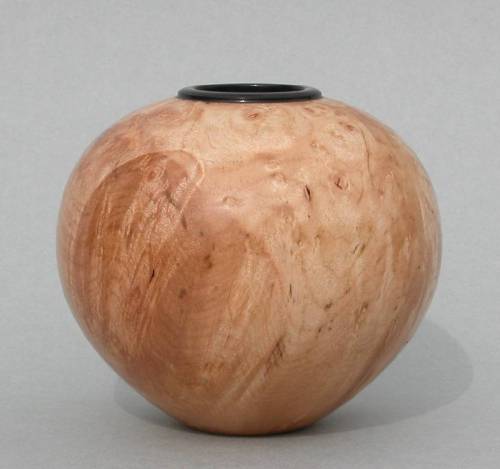 |
Fron that big pile of wood just above, comes this little hollow form.That maple burl is such pretty stuff, and a turner will not want to waste any of it at all. So here is a little form turned from one of the cut-offs of the very large piece I have started and which is described in steps below. In the photo of the pile of wood, it is the piece standing second from the upper left, at 30" in height. This little vase is 3" tall and almost the same at its widest diameter. The ebony collar is turned under on the inside. The piece is very thin and light. It is finished with Danish oil and buffed.
|
||
 |
 |
|
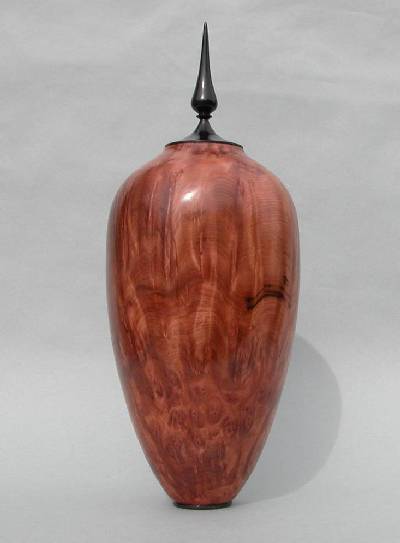
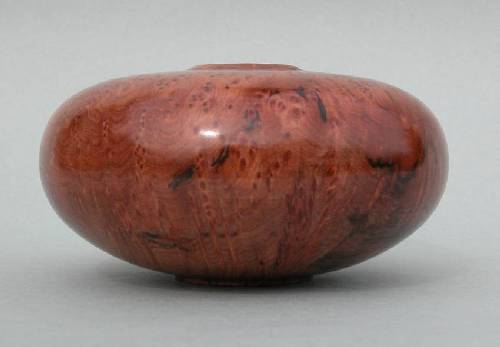
That Brad Adams is such a nice guy. He lives in California, and he knows how much I like to turn redwood. He has made it a personal quest to find me some pieces to turn. One day, a nice piece arrived at my doorstep, and it was perfect for what I had in mind. I love the tall forms with the finials, and I could cut a couple of pieces off the end of the square for some short hollow forms. The tall form on the left is a beautiful piece of wood, and I think the shape has done it justice. The finial is ebony, and the piece stands about 12½" tall, including the finial. The piece on the right is one of the two small pieces I cut off the end, and is about 4" in diameter and 3" tall.
|
||
 |
 |
|
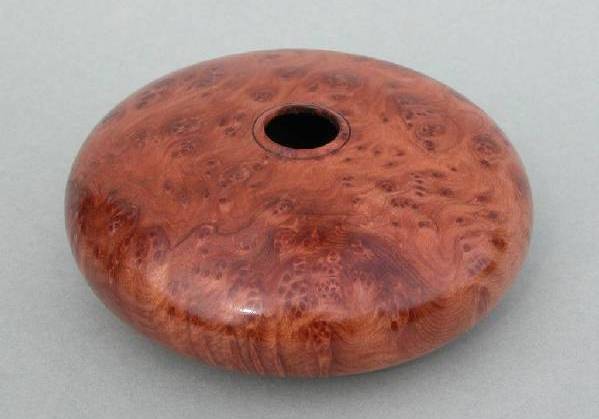
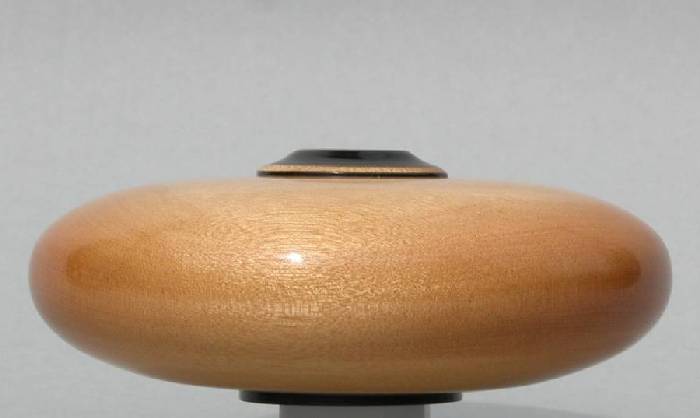
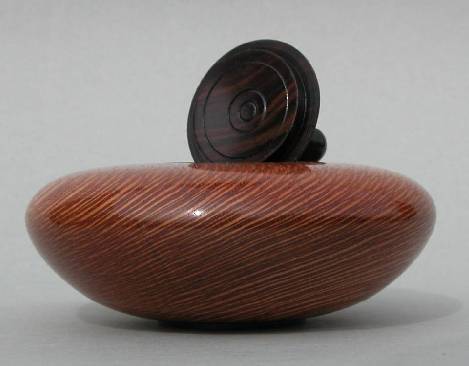
The little redwood hollow form on the left is the third piece I was able to turn from the wood sent to me by Brad Adams. I was very fortunate to acquire this gorgeous wood, and this form is especially designed to show off the "eyes" of the burl wood as much as possible. The small entry hole (3/4") makes it possible to show as much surface as I can. The piece is 4" x 2" with a buffed Danish oil finish. It is very light and is meant to be a purely ornamental piece for those that like the look and feel of beautiful wood. On the right is a 5" x 2" yellowheart form with a layer ebony and yellowheart collar. This is another purely ornamental piece, designed for no purpose other than to be seen. It was my first experience turning yellowheart and I was covered with yellow shavings and dust from head to foot. It's a nice wood to turn, but sure colors things up in the shop - or studio, as some would call it. I still consider myself somewhat of a wood butcher, but I have been called an "artist" from time to time. An artist would call his place of work a studio, so you decide for me. What is it, a shop or a studio?
|
||
 |
 |
|
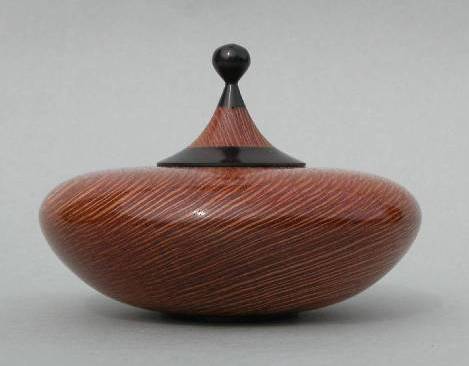
"Grandpa", said Reyanna, my eight year old grandaughter, "these little boxes are soooooo pretty." She'd walked along on the couch a dozen times to pick the little boxes off the shelf and open them and "oooooh" and "aaaah" over them. Now, even dumb ol' Grandpa can take a hint, and I decided to make her a special little "keep" box of her own. I had one partially done, and while she glued up little pieces of wood with hot glue in my shop and then painted her creations, I started working on this little box. She hasn't seen it yet, but I know she will be delighted to get it. It reminds Karen of Aladdin. It is of lacewood and ebony, and is 4" in diameter by 3" to the top of the finial.
|
||
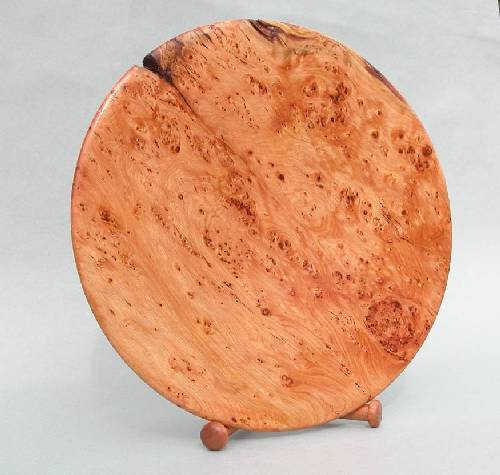 |
Marty is a fellow I met on the Internet. He had seen my site and wrote to ask for some help. He is a beginning turner, living in New Jersey, and his story is sad. At work one day, he was crushed when some very heavy boxes fell on him. Since then he has been unable to find work because of his injuries, and decided to try to make a living at woodturning. Marty is a creative and interesting fellow, and his willingness to try anything new and different is amazing.He also collects and sells wood to turners, and one day he sent me a nice piece of cedar burl that he had come across. It was almost the size of the platter you see here, 12" square and about 1" thick. This is very pretty wood that soaks up oil like a sponge. It took a long time to dry, but the end result is certainly worth it. Thanks, Marty.
|
||
 |
 |
|
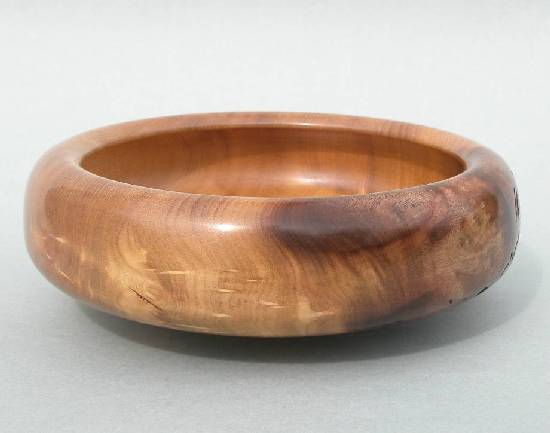
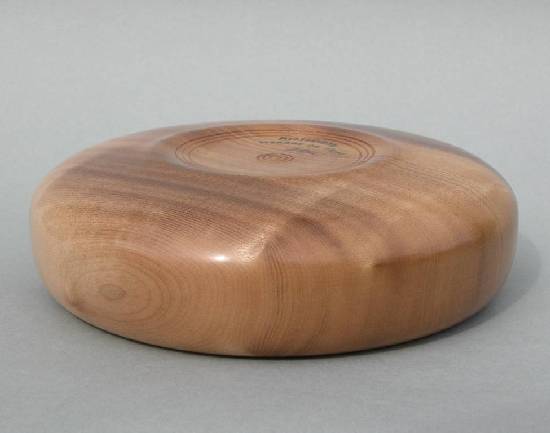
Brad Adams also sent me a nice piece of wood that grows along the coast called myrtlewood. A creamy, soft colored wood, with a luscious feel to it, the rough piece begged to be turned into a bowl that would have a soft look. For me, it seemed a perfect candidate for a rolled rim bowl. I am especially fond of rolled rims, in which the rim of the piece rolls over and is actually hollowed up and in on the bottom side of the rim. Difficult to do effectively, and a bit risky, it creates a nice effect. Both this piece and the cocobolo piece that follows are given this treatment. Most people don't really consider the bottom to be that important because, after all, the piece just sits on it, doesn't it? Well, I'm a bit of a "bottom man", (go ahead, take that the wrong way - you'd be right :)) and most woodturners I know are the same. They will pick a piece up and immediately turn it over to examine the foot and bottom treatment. In this case, I tried to follow smooth, undulating curves all the way around the piece. There is not a sharp angle anywhere on it, and the rim on the bottom is just a raised ring for it to sit on. This is an incredibly lovely wood to turn, and I really thank Brad for sending it to me. It is about 8" in diameter and 2½" high. Finished with Danish oil and buffed.
|
||
 |
 |
|
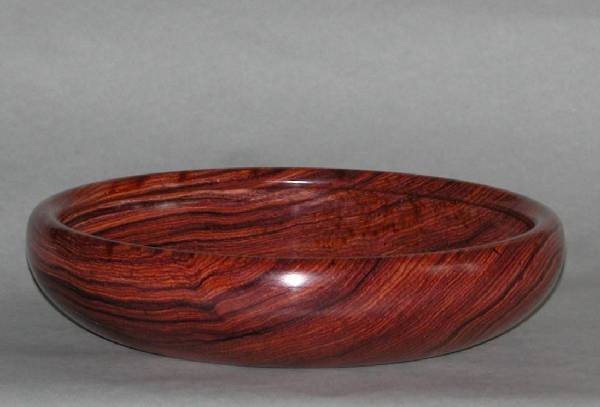
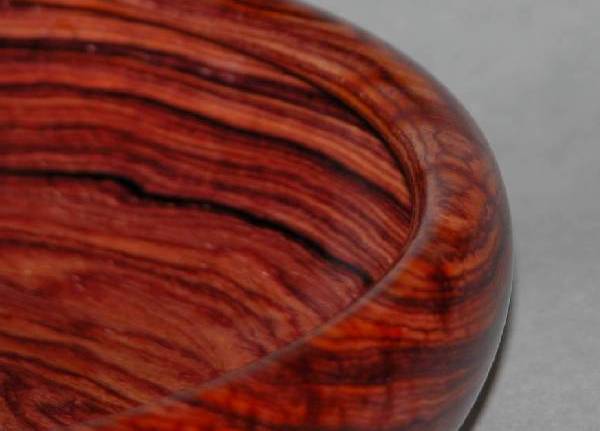
I like Steve Mushinski. I also like his mother, who brought me a lovely piece of cocobolo from her son in Ontario. She was visiting family in Manitoba and called me at the office to say she was in town and had something for me. Steve had taken a lot of photos at the Florida Symposium of the American Association of Woodturners. He had burned them onto a CD for me and that was what I thought I was getting. Mrs. Mushinski had the CD all right, but she also had the cocobolo with her. It certainly increased her luggage weight, as it is a very heavy wood. I had a very nice chat with her and when I got home that evening I rushed into the shop (studio?) to turn this. I had never turned cocobolo, so I did not know what to expect. Wow - is this wood ever HARD! And RED! It was a challenge to turn, and everything was covered in red dust when I was finished, and Karen said that my shirt was almost impossible to get clean. Cocobolo is also a very oily wood, and I suppose that was why. Like the myrtlewood, the rough blank suggested a rolled rim bowl, and that is what I did with this. I've included a close up of the rolled rim to give you a better idea of what I mean. You can clearly see how the rim of the piece rolls over. It is hollowed up and in on the bottom side. Cocobolo finishes beautifully. In fact, it requires almost no finish. The piece, as shown above, has no finish on it at all - it is just the bare wood as it came off the lathe. The bowl has now been waxed and buffed, but that's all. The bowl is 8" in diameter and 2" high.
|
||