2003 Turnings

Here it is, the very end of 2003 and I am just starting to put together the page for this year. I wish I could say it is late because I have been too busy turning, but that would not be true. I have been procrastinating, and repeated reminders from people who visit the site have finally prompted me to start putting my 2003 work on the site.

Last year I said I was starting into the big pieces, and that was true. However, in 2003 I also began working on smaller ones too. This came about due to the influence of my friends on the World of Woodturners website (WoW), (www.thewows.com) which I started in November of 2001 and which I still administer. There are over 700 members on the WoW site and many of them, like 280, have personal photo albums of their woodturnings. If you want a username and password for the site, email me.

At any rate, some of the WoW members are world-class turners, and many of them do very small pieces. Being a bit fickle (and having a short attention span) I decided that small is also OK. It's also a heck of a lot faster to turn out a small piece than a large one. Actually, it makes me feel better if I just think of it as a stage in my development as a woodturner. In my view, the art should never stop developing. I am still making many of my own tools and enjoy tool making almost as much as turning. I had a lot of fun making a fiber optic light to illuminate the interior of pieces as I turned them. There's an article in the "Tips and Tricks" section of the site that shows how to build one.

So, look at these works and enjoy them. Thanks for visiting the pages, and please let me know you were here.

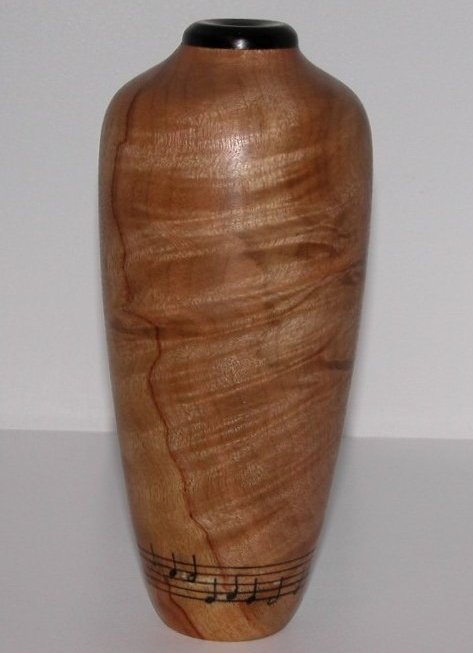
Close Thine Eyes

This is a piece I just completed that will be donated to the Winnipeg Philharmonic Choir for a fund raising auction. This is a fine choir of 80 years duration, which sang at Carnegie Hall in 1997, during my term as President.

The title comes from a feature piece of the choir,

"Close thine eyes and sleep secure.
Thy soul is safe, thy body sure.
He that guards thee, He that keeps
Never slumbers, never sleeps."
The notes on the piece are the actual music of the first phrase of the song.

The wood is camphor, from my good buddy Brad Adams. He gave it to me in Pasadena this summer when we were at the Woodturner Symposium put on by the American Association of Woodturners. Camphor is wonderful wood to turn, and its aroma fills the shop and clears your sinuses. This little piece is 8½" tall and not quite 3" in diameter. It is extremely thin and light and delicate.

The finish is Deft Danish Oil and buffed.

Birch Bowl Re-visited

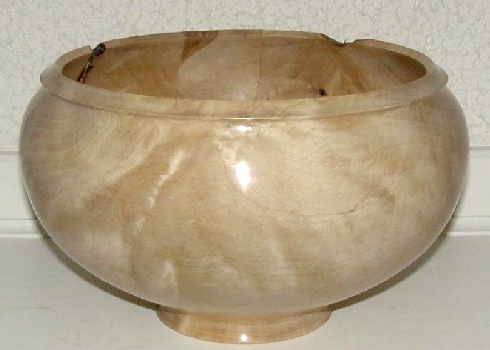
I first turned this bowl in 1998. I never liked it. I thought it was too thick and heavy and the finish sucked. Karen disagreed, and until 2003 she was able to keep me from re-mounting the thing and turning it into a different bowl.

I won - Yaaaaaaay.

This is the result, a much slimmed down, more nicely shaped and better-finished bowl. This has a tough water-borne urethane finish, hand rubbed to a soft sheen. It is still 14" across and 8" deep, but at a bit more than ¼" thickness it weighs one third of its former weight.

Now if someone could just do that with me....... :))

Click here to see what the original looked like.

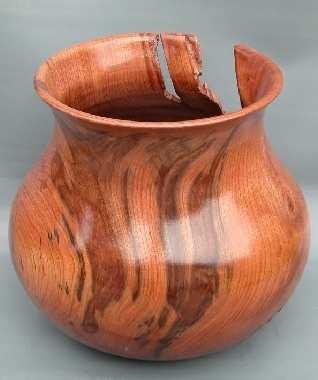
Cherry Pot
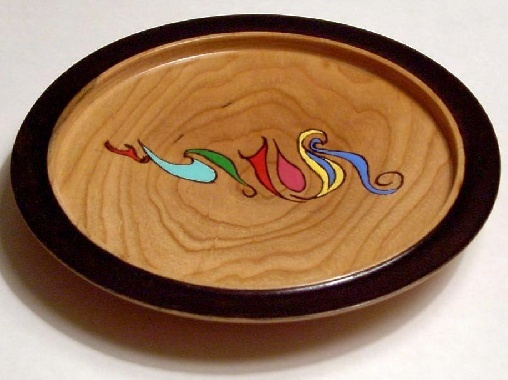
Doodles One

The piece on the left came from a log my friend's brother-in-law had on his farm in Quebec. Mike called me one day and said, "Hey Herm, I told you I'd get you some wood for working with me on my turning. Well, I'm out at the perimeter highway with four big cherry logs. A trucker called me and told me if wanted this I'd have to come and get it, 'cause he's not licensed to come into the city. Do you want a piece?"

Well, I couldn't say yes fast enough, and Mike showed up with his van's rear springs completely compressed. The four logs were 24" in diameter and about 30" long and weighed a LOT.

Anyway, Mike, here's one of the pieces. I cut the log on the "bias" for this 14" tall, 12" diameter pot. Finished with urethane and hand rubbed.

The piece on the right is from the same log, and is 6½" by 1".

When I'm in meetings I often just randomly draw. Now don't get me wrong - I DO pay attention. Anyway, one day I looked at the drawing and thought of putting it on a little plate and coloring it. Here's the result, and I may (or may not) follow this up with others. This one was an experiment. The colors are simple acrylic paint and the finish is water borne urethane.

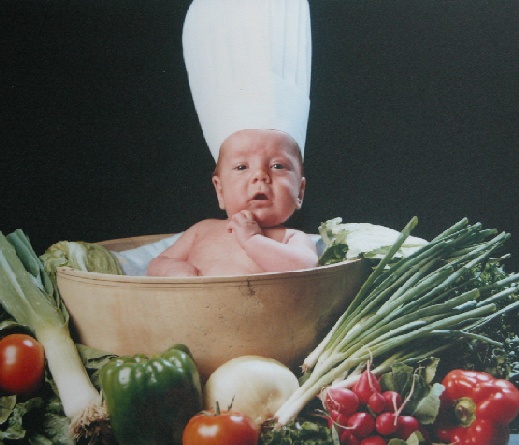
Lukas the Magnificent

The Manitoba Maple was threatening to come down on top of the house. The house was on the beach at Dauphin Lake, right beside my sister's home. From the rescued wood I was able to turn a monster bowl, 16" by 8" (See original) that is used for serving salad for our big family gatherings.

The bowl was left in the care of my nephew, Larry who is, appropriately, a chef. After 19 or so years of childless (not due to lack of trying - nudge, nudge, wink, wink) marriage, little Lukas surprised Larry and Virginia with his sudden appearance. A tiny preemie, he has grown like a weed and now fills out my bowl rather nicely, wouldn't you say?

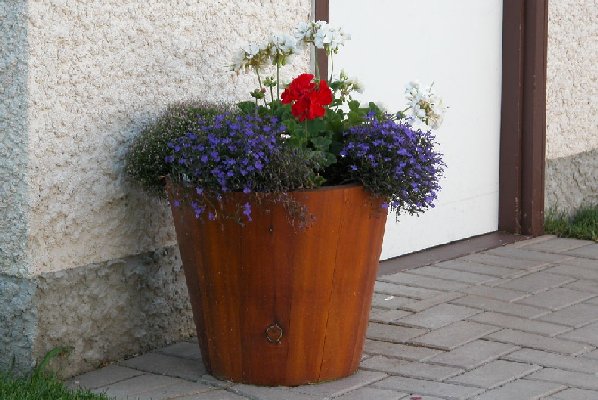
Cedar Flower Pot

This is a simple project for your yard. It is made of cedar 2x4's, tapered, mitered and glued into an octagon for the basic pot. I used polyurethane glue for the joints, and Sikkens Cedar stain for the finish. Made four of them for our backyard and they turned out beautifully.

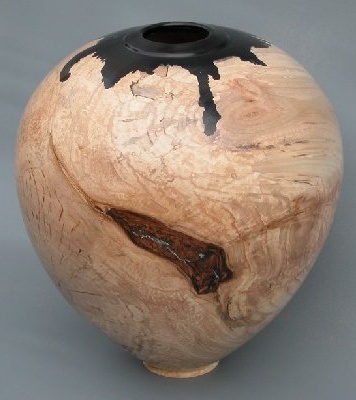
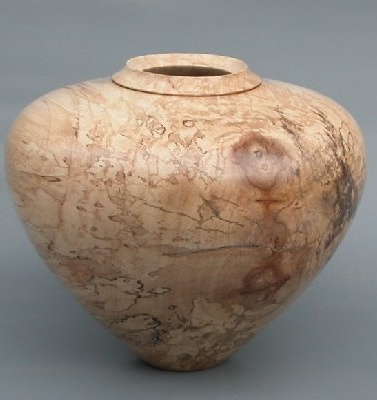
The hollow form on the left is of silver maple. The wood was given to me by a friend to whom I had given a few turning lessons.

The piece was an experiment. After it was turned I used a bit of black shoe dye on the rim. I wondered what would happen if I let it turn slowly and added a bit more dye, and this is the result. A "random flow" of the dye propelled by centrifugal force down the sides of the form. Then the piece was given three coats of water borne urethane. The final finish is wet sanded by hand with 1000 grit paper, and finally a wax applied with steel wool. It feels like silk to touch. "Random Flow" is 9½" high by 8" in diameter.

The right hand hollow form is of spalted birch. It is 7" in diameter and 6" high. The wood is a remnant left over from a neighbor's tree taken down a few years ago.

Random Flow
Silver Maple Form

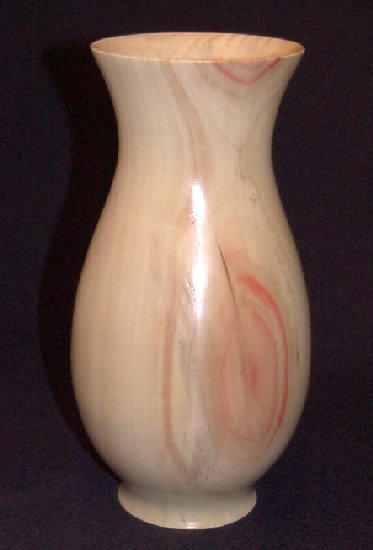
Not much to say about these two. The one on the left is a vase of Manitoba Maple, or box elder. It stands 9" high and is 4½" in diameter, Finished with urethane.

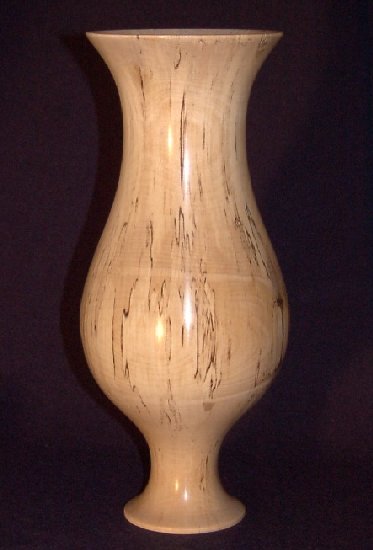
The vase on the right is spalted silver maple. Spalting is the black streaking that occurs when the tree is just beginning to decay. This vase is 12" tall and is 4½" in diameter.

Manitoba Maple Vase
Spalted Maple Vase

Ebonized Oak with Brass Shavings
Ash and Walnut Vase

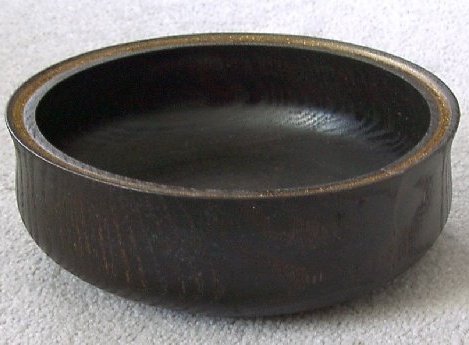
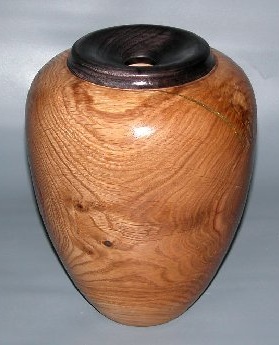
Manitoba oak is a ferociously difficult wood to turn. When wet it cracks and splits and moves all over the place. When dry it is extremely hard, dusty and brittle. However, it is a wonderful wood to blacken, or ebonize. I use a jar of vinegar with a wad of steel wool that has been in the vinegar for 3 weeks or so. The clear liquid, spread on the wood, reacts with the natural tannin in the wood and blackens almost instantly. Then I cut a groove in the rim and filled it with shavings of brass and epoxy. The bowl is 7½" in diameter and 2½" high. My sister, Helen, claimed this bowl and it now lives at her house - filled with fruit, I presume.

The piece on the right is 9" high and 5" in diameter. It is Manitoba ash with a walnut rim. The piece has some natural cracks in it, and I filled those with brass glitter from the art store and epoxy. It worked so well that the first person that saw this piece bought it from me.

Manitoba Ash Vase

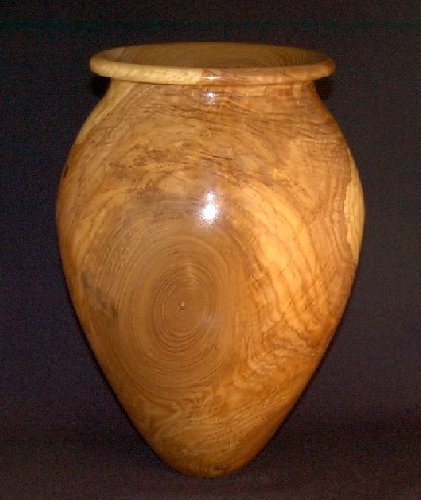
The ash tree grew on the shores of Lake Dauphin, and my sister Mary and her husband Charlie kept some large pieces of the tree for me. Ash is a lovely wood to turn, cleaner than oak but almost as hard. This piece had some remarkable figure that did not really show up until it was finished. The vase seems to glow. Another feature I added to this one is the rolled rim. It cannot be seen in the picture, but the rim is partially hollowed as well. The vase is large, 15" tall and 9" in diameter. Finished with Danish Oil and then top coated with urethane.

Aspire
Poplar Pitcher

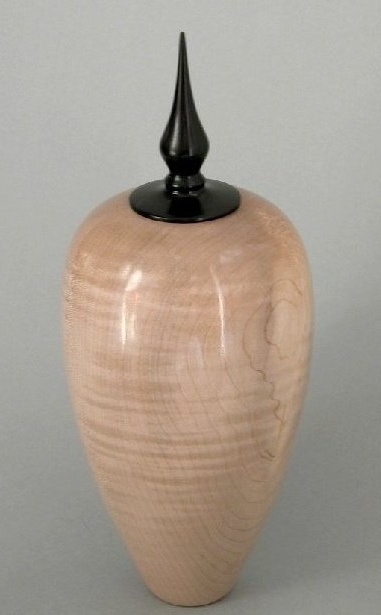
Fiddleback maple is such beautiful wood, and contrasted with the blackness of ebony, it is striking. After seeing some finials on the work of my friends on the WoW (World of Woodturners) site, I decided to try one. This piece is 13½" tall, 5" in diameter, and with walls of 1/8" it is very light. The finial does not come off. It is finished with water borne urethane, then hand rubbed with wet 1000 grit sandpaper, then steel-wooled to a fine sheen and waxed. This is my first finial, ever, and I'm rather pleased with it.

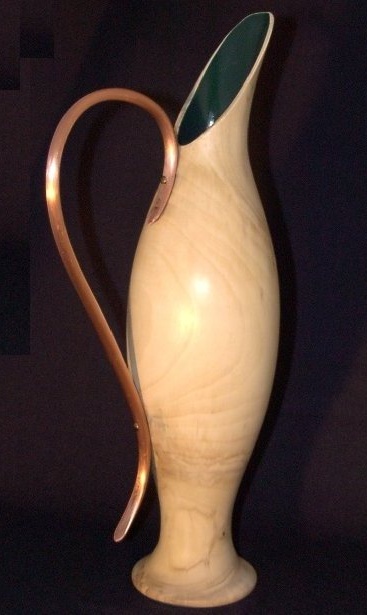
The piece on the right was an experiment. I saw a similar piece and thought I would try it with our local wood, poplar, since there is so much of it. It is mostly used for firewood. This piece is 16" tall, 1/8" thick. The outside is finished with urethane, and I painted the interior with dark green paint to match the carpet in our family room. The handle is a piece of ¼" copper tubing, formed into shape and then buffed and lacquered to hold its shine. The piece has gotten more compliments than I ever imagined it would.

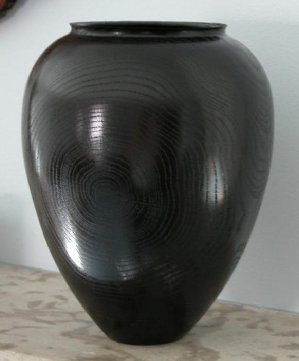
Ebonized Oak

This oak vase was blackened with black shoe dye. Then it was given several coats of Danish oil and finally buffed with the Beall system. It is 8½" tall and 6½" in diameter.

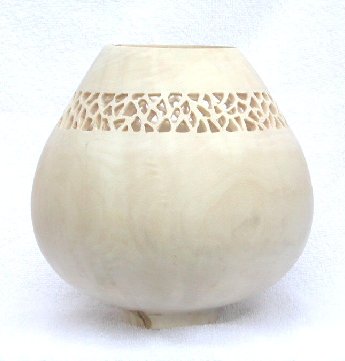
The bottom photo is a small poplar vase I made as an experiment. I turned it fairly thin, about 3/16" and then randomly drew a pattern around the top. The pattern was pierced out using an air drill, like a dentist's drill. This is the first pierced piece I've done, and I discovered that the vase needs to be thinner. The poplar was also bleached.

Pierced Poplar

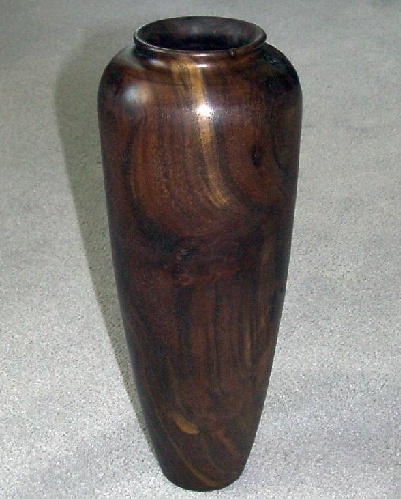
Claro Walnut Vase

This vase comes from some walnut pieces I got from Howard Klepper in California. You have already seen several vases, including two very large ones, turned out of wood I got from Howard. This vase is about 11" tall and is 4" or so in diameter.

I finished it with several coats of Danish Oil and then buffed it with the Beall buffing system. I may end up sanding the finish off, and re-doing it and actually filling the wood pores to get a smooth surface on the open grained wood.