Well, here it is, August 21, 2000, and I'm finally getting some of my work for the year 2000 posted on this page. Enjoy the work, and let me know if you have any questions or suggestions. Just hit the e-mail button in the other panel and send me a message.
 |
 |
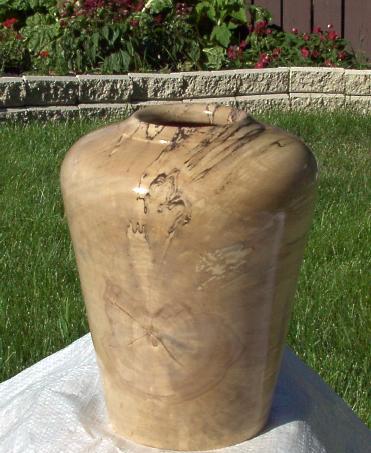
The 8" by 6" spalted birch vase on the left, finished with urethane, hand rubbed, and then 8 coats of automotive "clear coat". The finish is deep enough to dive into, although it's hard to see here. This vase now sits in neighbor Joe's living room filled with silk flowers. It came from a weeping birch he had to cut down two years ago. It was a beautiful tree, and he had tears in his eyes as we cut it down. I stored the logs outside on the dirt to spalt them.
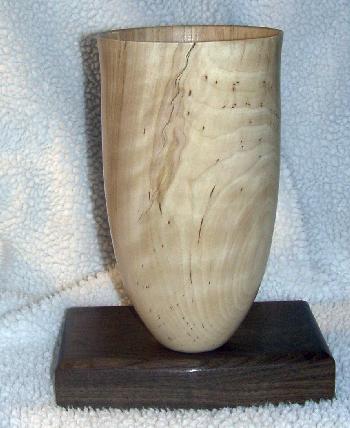
On the right is an 11½" by 6½" elm vase from my brother's tree. This was a straight end-grain cut, and was hollowed using a ring tool and "Cajun" Savoy's great chisels. The vase is only 3/16" thick. By the way, it's sitting on a piece of walnut for the photo - that's not a part of the vase.
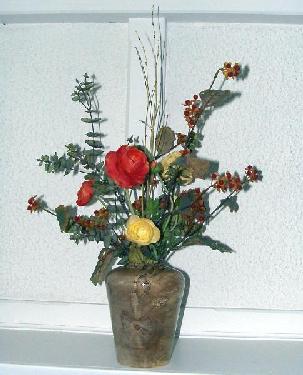
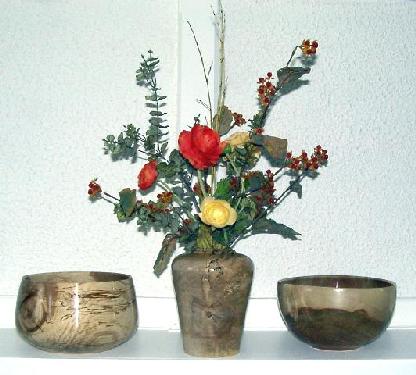
Below is the birch vase as it looked when we took it over to Joe and Barb, and on the right as it looked in our family room along with two earlier bowls.
|
 |
 |
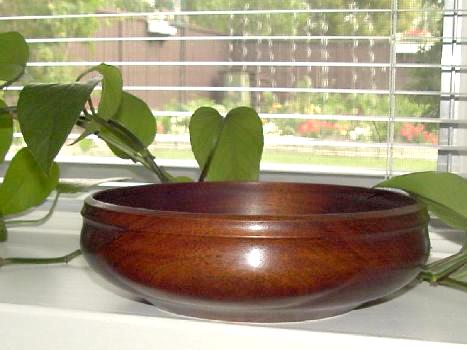
The 9" by 3" mahogany bowl on the left has a red mahogany oil stain on it, then rubbed out varnish.
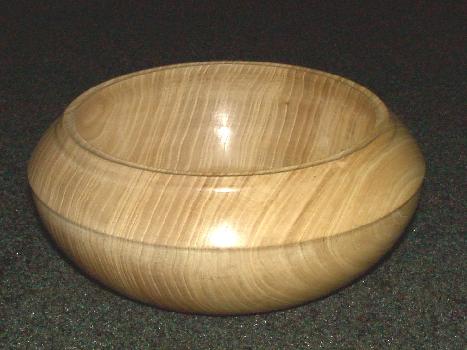
Roy Johnston, a friend of mine, owns a tree service, and he loves wood. He has a lovely new home, and in his large basement he has stacks of salvaged wood he can't bear to part with. He's given me a few pieces of this ash (this one was marked "1983"). The wood is beautiful and this little 8½" by 3½" bowl was made from some of it.
|
 |
 |
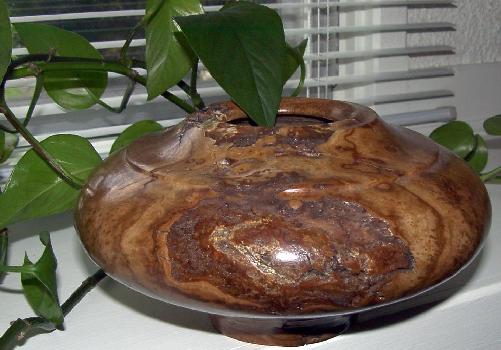
This cherry potpourri bowl is a remnant of a larger piece I was working with. The beauty of the grain dictated the kind of bizarre shape. It's one of those Fonzie (Henry Winkler - remember him?) pieces. He's about to comb his hair and then realizes it's already perfect. Well, this piece was like that. I was about to start really cutting into it, and suddenly realized I liked it the way it was. It's 7" by about 4", and oiled.
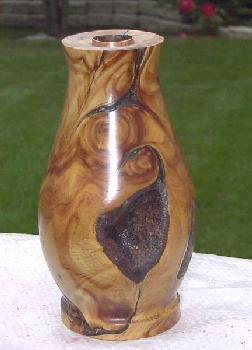
The piece on the right was one of my first turnings, back in 1995, so it really doesn't belong here. However, someone wanted to know what juniper looks like, and here it is. This little bud vase came from a bush I uprooted in front of my house. It's 7" tall. The finish is Danish oil.
|
 |
 |
 |
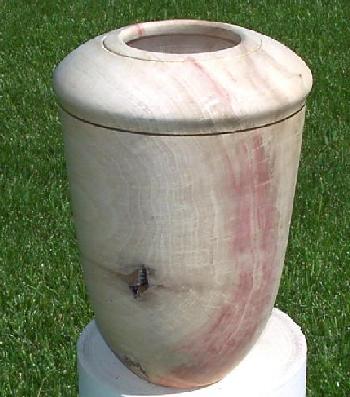 |
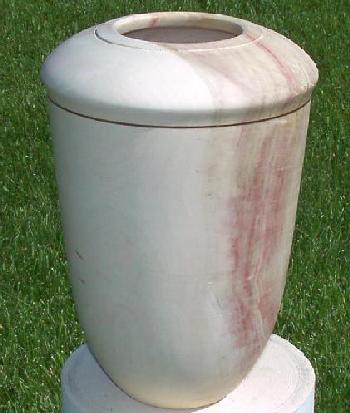
This maple vase came from the same rotten piece of maple as the bowl on my 1999 page. This was a challenge, but made much easier with the use of PolyAll 2000, a resin product sold by Lee Valley that stabilizes the rotten wood. As you can see, the results, especially on this colorful maple, speak for themselves. This vase is 9½" tall and 7" in diameter. It's finished with water-base urethane and hand rubbed.
I have another piece that I'm working on, further down the page, that I will be taking to my November seminar at Lee Valley, which is also treated with the same material.
|
 |
 |
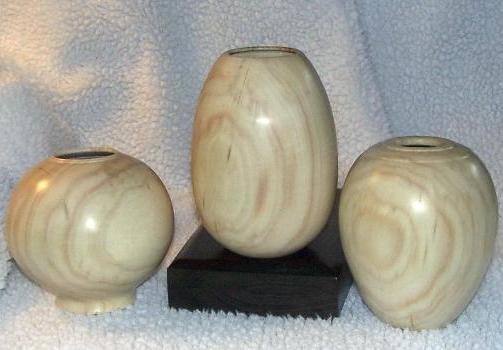
Above, left, is a set of small maple vases. The largest is about 7" tall and 4" in diameter. These are extremely thin walled. With the largest one, I can see my fingers holding the vase through the translucent walls. They are finished with urethane and - carefully - hand rubbed.
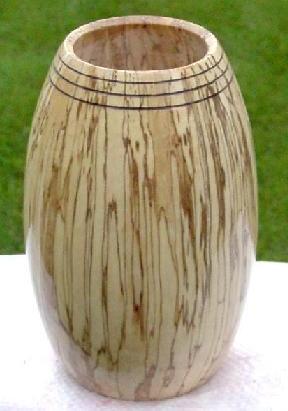
Upper, right, is a small vase, 6" tall I made from some of the spalted wood my buddy from Nova Scotia, Winston Spates, sent me.
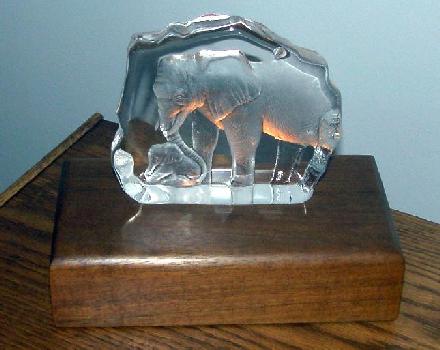
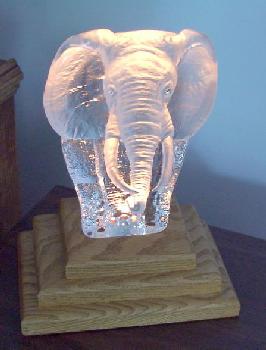
The pieces below aren't turned items, but I thought you might like to see them. Karen collects elephants and I've gotten her several large crystal pieces. These are outstanding if you light them from underneath, which is what I did with these boxes of walnut and oak. A simple night light does the rest.
|
 |
 |
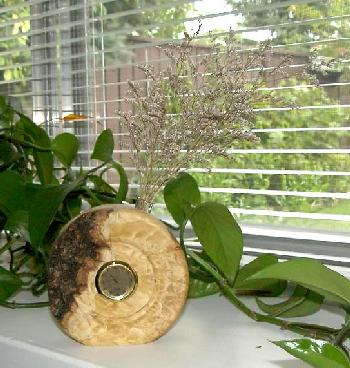 |
Got some small pieces you don't know what to do with? Here's an idea, especially if it's got some interesting grain and maybe a bit of bark on it. The little piece at the top is made of Manitoba Maple and has a small ½" test tube that can hold a few buds or dried flowers. I just stuck a little clock face on the front of it. Karen likes it on her desk.
Seriously, I have a very difficult time throwing away any hunks of wood. The funniest is one that I snatched out of the fireplace even though it was already ablaze. By the time I got it into my shop and looked at it again, I had forgotten what it was that I saw in the piece as it lay blazing in the fireplace. Good thing Karen wasn't home when I did this - the house had time to air out.
So, even if you don't have a clue what you're going to do with a piece, don't be too quick about destroying it. Anyone can work with a nicely kiln dried, solid piece of timber and make a salad bowl out of it. What I am interested in is finding gems inside of junk. Sort of like the guy that spends each morning out at the local dump looking for things he can fix. Ah well - I'm off on a tangent.
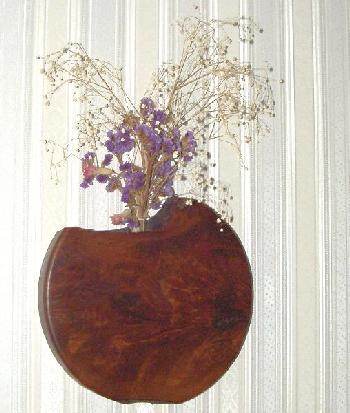
The lower piece is made from a hunk of redwood I found at a garage sale. It's about 10" in diameter and is barely thick enough for the 1" test tube I put in it. The redwood is a spectacular wood, but it's hard to get the grain right in the photograph. I'll have to re-shoot it one of these days.
|
 |
 |
 |
 |
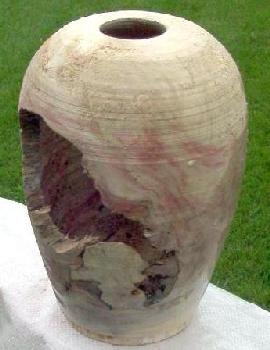
On the left is a rough - very rough - turned piece of Manitoba Maple that was so decayed I had to treat it to get it this far. It is from a burl that my friend, Roy Johnston, found when he was taking down a big tree. This piece is 13" high, and has a huge hole that runs right through it, as you can see. It was on display at Lee Valley Tools in this condition, and put on this page as a "before" picture. I then finished it at a seminar in November at Lee Valley with the promise that, even if it broke up into a million pieces, I'd photograph them and show them to you, as the "after" picture.
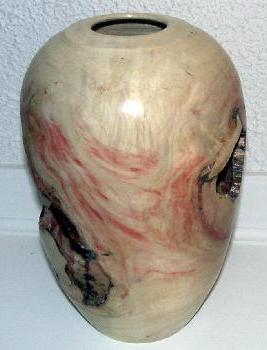
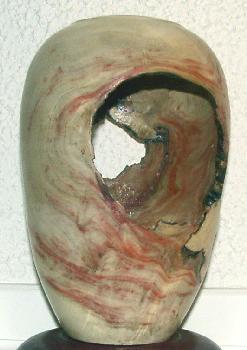
(December, 2000) Well, here are the "after" pictures on the middle and right (I hope you can tell). I can tell you; this was a fun piece to try to finish in front of a room full of people, and probably not too smart. You need to focus ALL your attention to turn something this fragile. Any distractions can be disastrous, and I probably won't try something like that again. I'm pleased with how it turned out, considering that I could have poked my finger through the wood before I started with it. The interior is not as smooth as I'd like, the price you pay for trying to completely finish a piece before time runs out.
Jon Schilling - I've taken your suggestion. The title of this piece shall be "A HOLE RUNS THROUGH IT!" :))
|
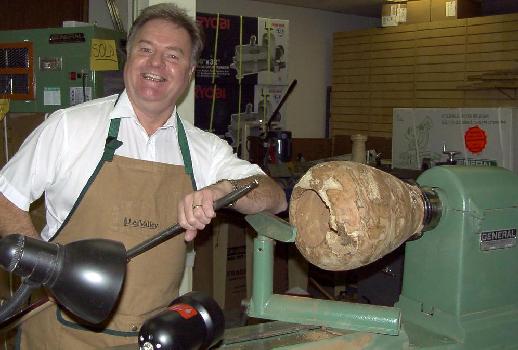 |
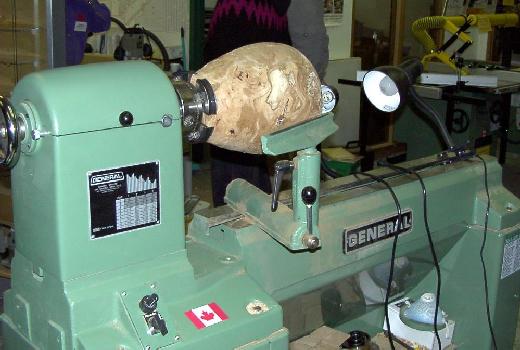
Now, this is one HAPPY dude. My singing buddy, Len LaRue took the picture as I put the big General through its paces during a two-day show at the Canadian Woodworker store here in Winnipeg. I'm suspicious that the storeowner, Cole, asked me to demonstrate the lathe because he suspected that I'd buy it once I'd used it. He was right.
The cherry crotch burl on the lathe started out at about 17" in diameter and weighed about 40 pounds. It was bone dry and was like turning concrete, except for the punky parts. I tried hard to stall the lathe with a 1½" roughing gouge, and it barely slowed down, once I figured out how to keep the belt from slipping. When I get this lathe home I will adjust belt tension so it does slip when I overdo the cut, just to avoid a nasty accident. The finished vase is below.
|
 |
This is a full photo of the new lathe. I just couldn't resist it. :))
|
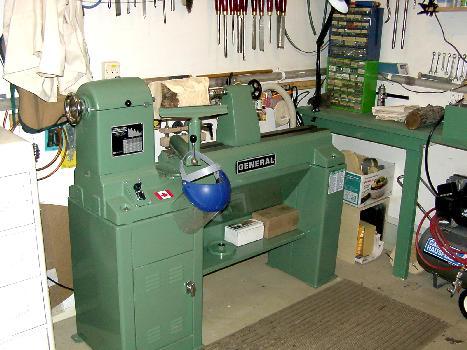 |
And here it is - home - in my basement, thanks to two strapping men from Canadian Woodworker that carried it down the stairs (in pieces, of course).
|
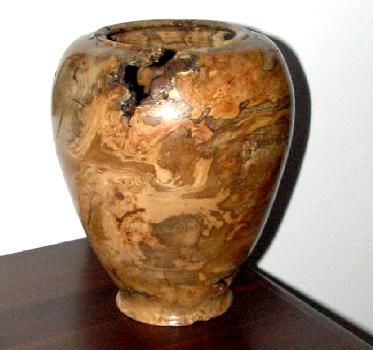
Here is the vase, finished at 12½" by 9½". I left the wall at about ½" in thickness since I didn't want to flirt with an accident at a public show and hurt one of the onlookers. The burl was extremely hard, and since it was on a crotch, every revolution brought around two sections of the trunk where I had to cut right across end grain. Other parts of it were soft enough to scoop out with my fingernail. The soft parts were treated with Polyall 2000 (Polyall 2000) when the piece was about 1" thick.
The Polyall 2000 is a miraculous product for treating punky wood. Here is a tutorial that I wrote about its use. (Polyall 2000 Tutorial)
As you can see, the resin treatment did not affect the finishing. The vase has three coats of water based urethane, hand rubbed with 600 grit wet sandpaper and then polished with mineral oil and rottenstone.
|
 |
 |
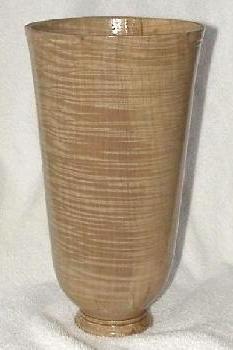
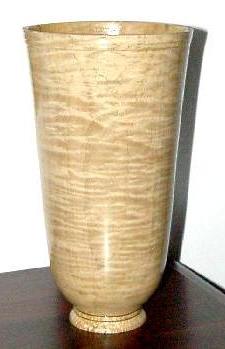
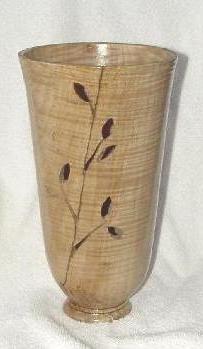
This vase is 12" tall by 6½" in diameter. It's from rotted old maple lying in the woodlot of my friend Bob Wenzel in Warroad, Minnesota. Bob is an excellent instrument maker, and this piece of fiddleback maple wasn't useful to him so we cut a piece out of the trunk for me to try. Well, Bob, here's the result.
The wood was mostly firm, except for the split down the side, so I treated it and finished the turning. I also epoxied the split since I was turning the piece at a public show and didn't have anything else with me to hold the thing together as I turned. After it was finished I wished I had not, so I turned the split into a vine with some leaves
|
 |
 |
 |
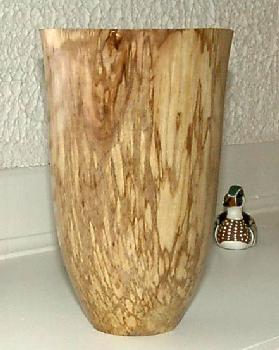 |
I had to include this little vase, 8" by 4", because of the duck in the picture. My kids, when they were little, presented me with a little ceramic duck every Christmas (I like birds) and this one happened to get into the picture.
The maple came from Winston Spates out in Nova Scotia. This was the first piece I ever did on the new General lathe, and I did it at a demo of the lathe in September. It's thin, about 1/8" and before the end of the show had changed shape rather dramatically by itself. It's now almost triangular. People couldn't resist picking it up.
|
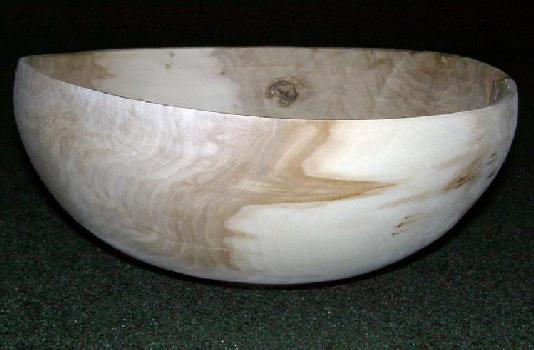
The bowl on the left still needs a lot of finishing. I included it because it is the only piece of willow that I've ever turned. A friend, Brad Magnusson, gave me a chunk from a huge willow they had taken down on their property. I turned the piece completely green and let it warp as it wished. As you can see, it has. I like the grain of this wood, and I will include a shot of it when it is finished.
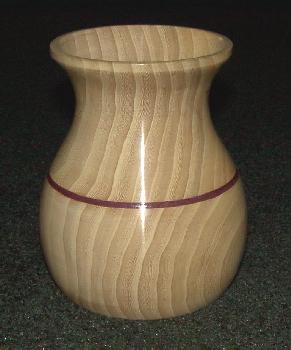
The piece on the right was glued up in two halves from some elm. After the vase was turned and hollowed, and almost finished, I cut a small channel right on the glue line and filled it with tinted Bondo (automotive body filler). If you want to turn Bondo, you have to do it quickly, before it has set up rock hard. It will dull a high-speed tool in just a second, so you have to turn it right away. After it gets rock hard it sands very easily.
|
 |
 |