1997 Turnings

Woodturning is fairly new for me. I've only been at it since 1996 and have come to love the relaxing and creative hobby.

As of now, December 2000, I've finally got the kind of lathe I've wanted all along, a General 26020VD. (There's pictures of it under the "2000" woodturnings. The first lathe was a Taiwan cheapie. After a few minutes of turning I knew I was hooked and that I'd have to buy a larger lathe. I had a Record mini lathe that was a wonderful piece of equipment, and then migrated to a Record CL348 x 30C lathe that I found at a garage sale, of all places. The biggest lathe made by Record, it was my primary lathe for several years. Almost all of the work on these pages until late 2000 was turned on that machine. I had it mounted on a closed plywood stand filled with about 600 pounds of sand. It was very solid. For awhile, if I had a really heavy piece I balanced it on the homemade monster in the garage first, before I mounted it on the Record.

The monster in the garage has a story. It came to me thanks to the Internet. I'd taken a day off work, and early in the morning I typed a message to the newsgroup saying that I was looking for a lathe. Ten minutes later my e-mail beeped. On his way to work, this fellow had spotted a homemade sign on the boulevard, advertising a lathe. He thought I might want to check it out. I drove down there, found the sign and ended up in the garage of a 90-year-old aircraft machinist. He'd made this lathe 35 years ago, and the guy he made it for never came to get it. It had never turned a stick of wood. I knew it was too big and heavy (about 700 pounds) to get it into my basement shop, but I bought it on the spot. I had to dismantle the thing to get it home. It worked well, but had some design flaws so I only used it for the really big pieces to balance them.

This story gets funny here.

He had some other stuff for sale (like a big band saw he's made himself to cut the 1" steel he used in making the lathe) and a set of golf clubs. I said, "Well, I see you've decided to hang up the golf clubs."

"Well," this spry 90-year-old said, "I only selling those because I'm having a new set made for me. I'll be picking them up tomorrow."

Now - that's a goal to strive for! New custom made golf clubs at age 90!

For holding the work, I mostly use a Stronghold chuck, for which I've got three sets of jaws. This is an excellent chuck, and I have never even seen a piece loosen up in the chuck, much less fly off.

I've made a number of my own tools, like scrapers out of big Allen wrenches, a long, extra heavy holder for the "Termite" tool for deep hollowing, a center rest using in-line skate wheels, and a disk sander which is powered by the rotation of the piece in the lathe.

Anyway, here are some of the pieces I've done. I hope you enjoy looking at them, although my photography often leaves something to be desired (hints would be helpful). I'd be grateful for your comments, pro and con, and would be happy to answer questions or trade information with you.
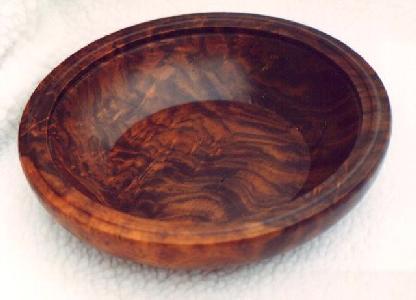
This walnut burl piece is 13" by 3½". I was fortunate to find the wood at a local Windsor plywood store, but it cost me a fortune. A friend saw this bowl, which my wife has claimed, and I turned a similar bowl for him. The bowl is finished with 3 coats of Danish oil and waxed


Walnut Burl Bowl

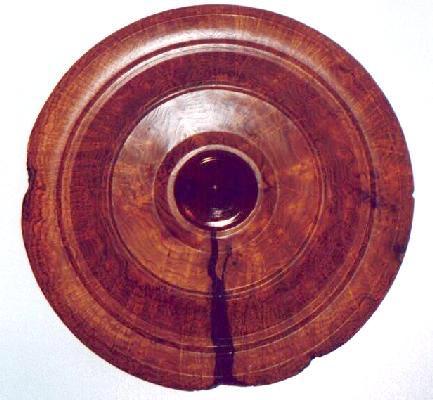
This is a wall hanging created from a 100-pound slab chain sawed off a root burl from a Russian olive tree that grew on the grounds of the Legislative Buildings in Winnipeg. It's about 26" across. I turned it green and left it in a warm basement over the winter. By spring it had cracked and twisted, so I drove some screws into the edge of the crack, clamped the twist straight and poured resin (tinted blue with artist's acrylic paint) into the crack. When it hardened I re-turned the piece. The disk in the center is red resin, with some blue swirled in it, and poured into a margarine container mold. When it hardened I simply popped it out of the margarine container and glued it on. The wood is finished with 2 coats of tung oil and waxed, and the resin has several coats of clear lacquer.

Russian Olive Wall Plaque

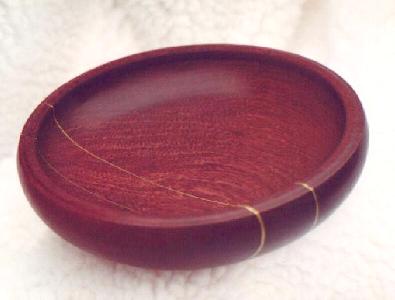
This purpleheart bowl is one of several I've made the same way, laminating either brass or aluminum with the wood. I prefer the brass, but it's pretty tricky to turn. Your chisels need to be very sharp to get a clean cut. It's made easier due to the density of the purpleheart, but even so, keep your sharpener close by.

My dear wife quickly claimed this bowl, which is finished with my own concoction of varnish, linseed oil and turpentine with a bit of drier added. It's also been waxed.


Purpleheart Bowl

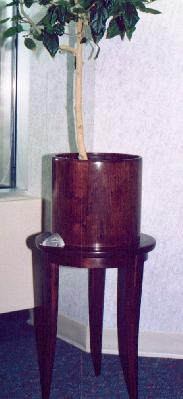
This is one of a pair of walnut planters in my office. I designed and built them with three laminated, curved legs so they would be rock stable. I think if I were to build them again I'd make them with four legs; they would look better.

The sides of the planters were glued up in a hexagon, then turned and glued into a groove in the base. They are finished with three coats of varnish, then rubbed out with 600 and 1000 grit wet-dry paper using soapy water as a lubricant.


Walnut Planter

This bowl is from a maple burl I found on a week long wood hunting trip with my buddy, Clem. I found the burl at Garland Miller's place in Wakefield, Michigan.

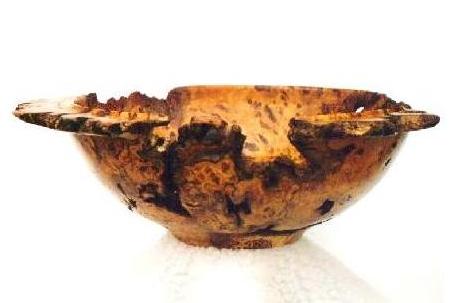
The natural edged bowl is 16½" across and 6½" deep. I turned that burl over and over and set it aside again a hundred times before I decided to start cutting into it. It ended up in just one big bowl, with very little waste on the outside. The burl was very old and brittle, and very, very difficult to turn.

I used four coats of tung oil on it, and now wish I hadn't, as it darkened up more than I wanted. It may have been better to use one or two coats of water based varathane and then rubbed them out. It's still a very attractive bowl that caught the attention of one of my wife's co-workers who bought it. Karen will never forgive me for letting it go.


Maple Burl Bowl

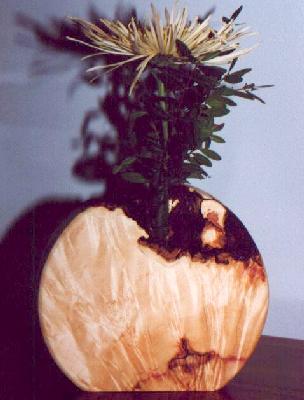
This is the first "hollow type" form I tried. It is made of Manitoba maple, which is really a box elder. On a drive through town, I spotted a giant root burl stump sticking out of the ground about 1½ feet. It was about 5 feet across. I went to the door and asked if I could have it. They said OK, and when I went back a couple of days later to cut it out his neighbor had already cut it up for me.

The color and grain of this wood is incredible, and my wife has threatened me with dire consequences if I even think of selling this vase.

It's about 9" tall and 4" in diameter. The only finish is several coats of wax.


Maple Burl Vase

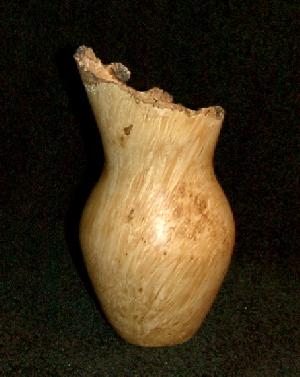
I've made a lot of these little vases, using the most peculiar wood I can find and test tubes bought from the University store. It's a good way to use some of the outer parts of the tree. The combination of rough bark and polished wood finish gets a lot of attention.

This vase was made from the Manitoba maple burl described above, and like the vase is finished only with wax.


Manitoba Maple Burl Vase

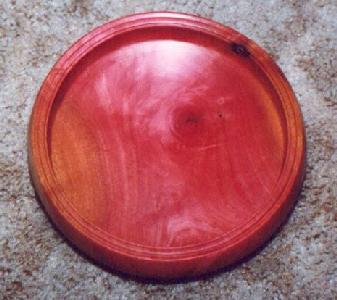
It's hard to find a prettier wood than pink ivory. It comes from Botswana and South Africa, and is called the "Royal wood of the Zulu's". The chief's son had to fell a tree and make a spear of this wood in order to reach manhood. Only Zulu royalty was allowed to possess this wood - anyone else caught with the wood was put to death.

The cost of the wood reflects its rarity and beauty. At it's price, it takes real nerve to start cutting into it. All I could think of was "what can I do with these beautiful pink shavings?"

The wood is very hard, but surprisingly easy to turn. It takes on a polish like no wood I've ever seen. All this 8" x 2" bowl has on it is a coat of wax.


Pink Ivory Bowl

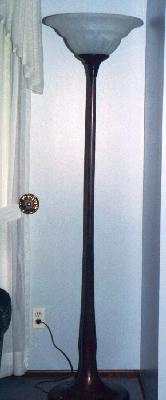
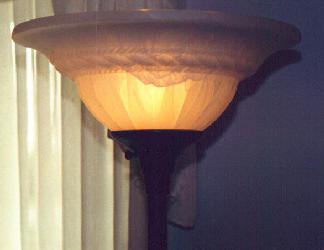
We looked and looked for a lamp to match all the walnut furniture I'd made for our living room. However, everything we saw was brass and aluminum and ugly. So, we ordered a glass dome that we liked and I made the rest.

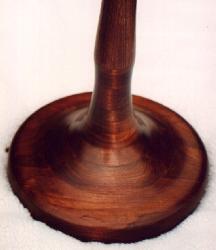
The base was glued up and turned separately from the main post. It's quite heavy, since we also wanted the lamp taller than normal. It stands about 6½ feet. The cradle for the glass was also turned separately and glued on.

It was quite interesting to mount the entire lamp on the lathe to sand the glue joints smooth. I turned the headstock on the lathe so the top of the lamp stuck out into the room, and my wife held the end of it and let it turn in her hand as I did the sanding.

The lamp is finished with three coats of varnish, rubbed out and waxed.


Floor Lamp


Lamp Top


Lamp Base

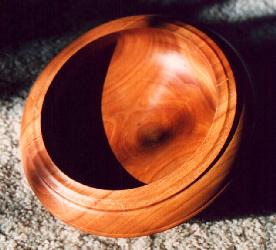
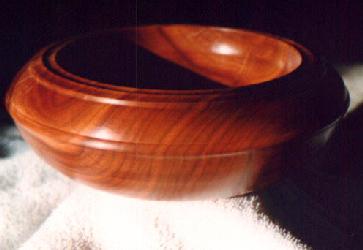
This is a set of cherry bowls about 9½" across and 3" deep. They are finished with my own concoction of varnish, linseed oil and turpentine, and waxed.


Cherry Bowl


Cherry Bowl

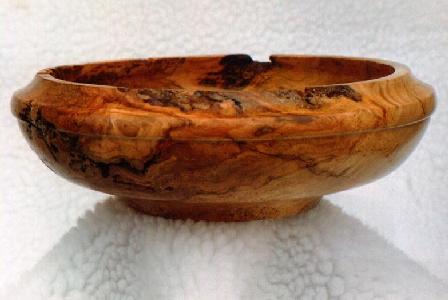
A cherry burl I found in Michigan yielded several nice pieces, but I'm especially fond of this bowl, about 11" by 4".

The bowl is finished with two rubbed out coats of water based varathane and carnauba wax on top of that.


Cherry Burl Bowl

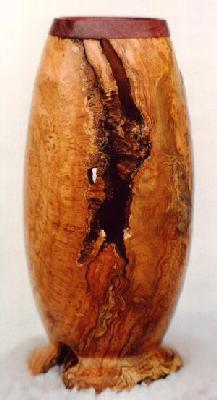
The same cherry burl had this vase inside of it. As you can see, it has voids on both sides, and I knew it would fly apart on the lathe. So, before I turned it I added a collar of purpleheart. This vase gets a lot of attention and I'm especially fond of it.

The burl was very soft in places, and required liberal doses of "Hot Stuff" to secure it. I managed to get the walls down to slightly less than ¼". It stands about 9½" tall and is about 4½" across.

This piece is also finished with two rubbed out coats of water based varathane and then waxed.


Cherry Burl Vase